


Yes, you pay AliExpress import tax on almost every order in 2026. In the US, the $800 duty-free de minimis rule is suspended for parcels from every country, so duty applies from the first dollar. In the EU, VAT has applied to all imports since 2021 and a flat €3 customs duty per item arrived on 1 July 2026. India cut its duty on personal imports to 10% in April 2026, but GST still sits on top. The UK is the outlier: below £135, you pay VAT at checkout and no customs duty.
This guide explains how AliExpress customs duties and import charges work in each market, what the "Import charges will apply" line on a listing means, how to estimate the real landed cost before you buy, and what dropshippers should do differently. Every rule below is linked to the official source, because these numbers changed several times in the last year.
AliExpress import tax by country: the 2026 summary
| Destination | Duty-free threshold | Tax on the goods | Customs duty | Where you usually pay |
|---|---|---|---|---|
| United States | None. De minimis suspended for all countries, all shipping modes | No federal VAT; state sales tax may be added at checkout | HTSUS rate plus any additional tariffs in force | At checkout if the seller ships duty paid, otherwise to the carrier or broker |
| European Union | None since 1 July 2026 | Local VAT (standard rates run from 17% to 27%), charged on every order | €3 per item for goods worth €150 or less; normal rates above €150 | VAT at checkout via IOSS for orders of €150 or less; otherwise on delivery |
| United Kingdom | £135 for customs duty | 20% VAT on most goods | None for non-excise goods worth £135 or less | At checkout up to £135; on delivery above it |
| India | No exemption for purchases | IGST on the value plus duty | 10% basic customs duty on dutiable personal imports since 1 April 2026 | To the courier or postal service before delivery |
What "estimated import charges" means on AliExpress
AliExpress now tells you on the product page whether import charges are expected. The wording depends on your delivery country and where the item ships from. We checked listings with a German delivery address in October 2026 and found two labels side by side:
- "Price includes VAT | Import charges will apply" on an AliExpress Choice item shipping from China. VAT is in the price, but duty (now including the EU's €3 per item) is extra.
- "Price includes VAT | No import charges" with "Shipped locally" on an item stocked in a German warehouse. No customs border, no duty.
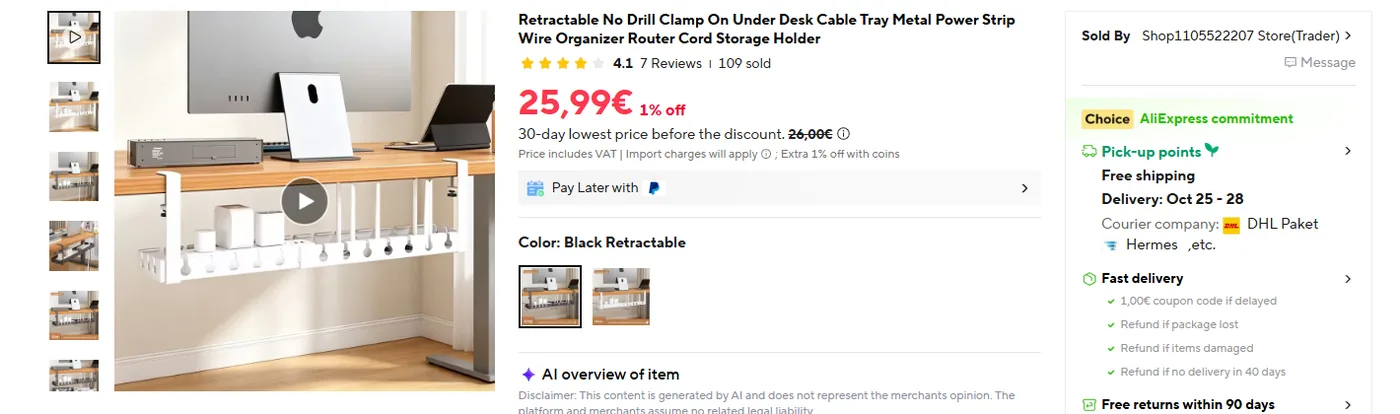

The site also shows this notice on EU listings: "For items delivered from outside the European Union, you may be subject to additional charges for VAT and, when applicable, customs duties in your country. If AliExpress is obliged by law to collect VAT, you will see the VAT inclusive price at checkout." In plain English: the checkout total is the best estimate you'll get, but it is an estimate. If an "Import charges" line appears at checkout, AliExpress is collecting it up front. If nothing appears and the item ships from abroad, expect a bill from the carrier.
AliExpress import tax in the US
The US used to be the easy market. Anything under $800 per person per day came in duty-free under Section 321. That ended in stages:
- 2 May 2025: duty-free de minimis ended for goods from China and Hong Kong.
- 29 August 2025: an executive order extended the suspension to shipments from every country.
- 20 February 2026: a new executive order continued the suspension.
- 24 June 2026: CBP published interim final rules suspending de minimis indefinitely for "all modes", including the international postal network, with a new mail informal entry process from 24 July 2026.
- 1 July 2027: the exemption is due to be repealed by statute under the One Big Beautiful Bill Act, so this isn't a temporary blip.
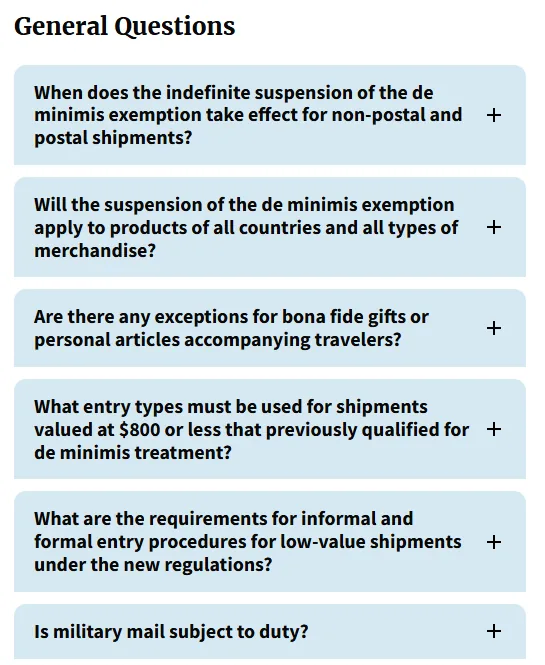
CBP's e-commerce FAQ confirms the suspension "applies to merchandise valued at $800 or less arriving via all modes", and that duty rates "are based on the HTSUS classification and the rates in effect at the time the entry is made."
How much are AliExpress duties in the US?
There is no single AliExpress duty rate, and any blog that quotes one flat percentage is guessing. Your duty is the sum of:
- the general rate for the product's 10-digit code in the Harmonized Tariff Schedule,
- any additional tariffs in force on the day of entry, including the Section 301 duties that already apply to many Chinese-made goods,
- and, if a courier clears the parcel, its brokerage fee.
The extra tariff layer has moved a lot this year. The Supreme Court struck down the IEEPA tariffs on 20 February 2026; a temporary 10% Section 122 surcharge ran from 24 February until it expired on 24 July 2026, and new Section 301 duties replaced it. Because these rates keep changing, check the code and the current rates when you price a product, not once a year.
State sales tax is a separate charge. CBP doesn't collect it, but AliExpress may add it at checkout depending on your state.
A US worked example
Say you order a $40 phone mount and, for its tariff code, the general rate plus additional duties come to 20%. Duty is $8. If the parcel arrives by express courier, add the courier's brokerage fee. If the seller ships it duty paid, the $8 should already be in the AliExpress checkout total and nothing more is due at the door. For more on what this did to US dropshipping margins, read how US tariffs killed the $800 de minimis loophole.
AliExpress VAT and customs duties in the EU
VAT applies to every order
The EU abolished its €22 VAT exemption on 1 July 2021, so VAT is due on every import, however cheap. For consignments worth €150 or less, the Import One-Stop Shop (IOSS) lets the seller or marketplace charge VAT at checkout and declare it monthly, so the parcel clears without a second bill. AliExpress acts as the collecting marketplace for these orders, which is why EU listings say "Price includes VAT". The rate is your own country's rate: 19% in Germany, 20% in France, 21% in the Netherlands and so on.
The €3 customs duty from 1 July 2026
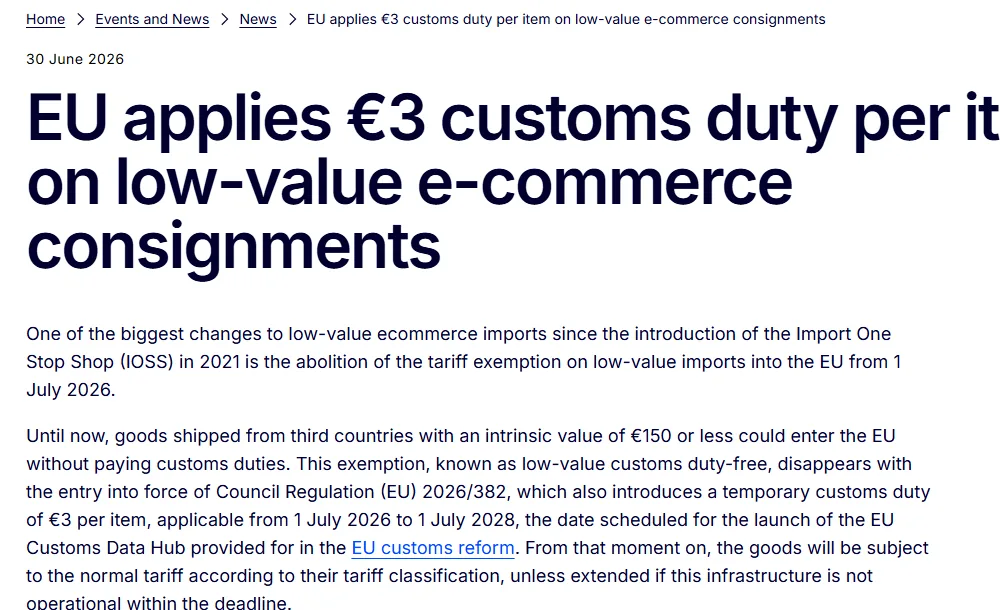
Until this summer, goods worth €150 or less paid no customs duty. Council Regulation (EU) 2026/382 removed that relief and introduced a temporary flat duty of €3 per item, from 1 July 2026 until 1 July 2028, when the new EU Customs Data Hub is due to launch. The European Commission's Access2Markets notice sets out the details:
- It applies to B2C distance sales worth €150 or less, regardless of whether VAT is handled through IOSS, special arrangements or standard import VAT.
- An "item" means goods in the consignment sharing the same tariff classification, not each physical unit.
- The Commission's examples: five T-shirts pay €3 in total; three T-shirts and a watch pay €6.
A separate EU handling fee for low-value parcels is still being discussed and could be added towards the end of 2026. Above €150, normal duty rates for the product's tariff code apply, plus import VAT collected on delivery. Our guide to AliExpress EU dropshipping VAT covers the seller-side detail.
An EU worked example
A shopper in Germany orders three T-shirts (€18 in total) and a phone case (€6) from a China-shipped AliExpress seller, all in one parcel. The consignment is worth €24.
- VAT at 19% on €24: €4.56, charged at checkout.
- Customs duty: two tariff classifications (T-shirts and phone case), so 2 × €3 = €6.
- Total on top of the goods: €10.56, or 44% of a €24 basket.
That last number is the real story of 2026. On cheap items, a flat €3 hurts far more than a percentage ever did. Ordering the phone case from an EU-stocked seller instead would have cut the duty to €3.
AliExpress import charges in the UK
The UK left the EU before the €3 duty, so it doesn't apply. Gov.uk's page on tax and customs for goods sent from abroad sets the rules: for goods worth £135 or less in total, the seller includes VAT in the price and there's no customs duty on non-excise goods. Above £135, VAT and duty are collected before delivery, and the carrier adds a handling fee. HMRC has confirmed the £135 duty relief will be removed, with March 2029 as the latest date. Sellers should read our full guide to AliExpress dropshipping in the UK.
AliExpress customs in India
India's 2026 Budget, presented on 1 February 2026, cut the basic customs duty on dutiable goods imported for personal use (tariff heading 9804) from 20% to 10%, effective 1 April 2026. Law firm Lakshmikumaran & Sridharan's Budget summary confirms the rate and date; certain specified goods are excluded and still pay more.
The 10% isn't the whole bill. IGST is charged on the value of the goods plus the customs duty, at the GST rate for that product.
An India worked example
For a ₹4,000 gadget in an 18% GST category:
- Basic customs duty at 10%: ₹400.
- IGST at 18% on ₹4,400 (value plus duty): ₹792.
- Total import charges: ₹1,192, about 30% on top of the item price, plus any surcharge that applies to your product.
There's a bigger practical problem for Indian buyers. The AliExpress app has been blocked in India since November 2020, and many listings simply don't ship to Indian addresses, so check delivery before you count on any product. If you're building a store for Indian customers, our guide to AliExpress dropshipping in India covers the workarounds and local supplier options.
How to estimate your landed cost before you buy
- Check the "Ships from" location. A local warehouse in your country (or the EU single market) usually means no customs at all.
- Read the tax line under the price. "Import charges will apply", "No import charges" and "Price includes VAT" each tell you something different.
- Find the tariff code. Use the US HTS search, the EU TARIC database or the UK Trade Tariff to find the code that matches the product's material and use, then note the duty rate.
- Do the math on the whole consignment. Add VAT or GST and duty, and in the EU count one €3 per distinct tariff line, not per unit.
- Add the carrier's fee. Couriers and postal operators charge for clearing parcels. In the UK, Royal Mail lists an £8 handling fee on parcels it collects charges for.
- Compare with the checkout total. If AliExpress collects import charges at checkout and your estimate is close, you're done. If it doesn't, keep your estimate handy for when the carrier asks.
Legal ways to pay less AliExpress import tax
- Buy from local stock. EU, UK and US warehouse listings skip customs entirely. Expect a slightly higher item price; it's usually cheaper once duty is counted.
- Group identical items in the EU. Five of the same product in one parcel pay one €3; five different products pay €15.
- Stay under £135 in the UK. One parcel at £140 brings duty and a handling fee that a £130 parcel avoids.
- Choose duty-paid shipping where offered. You pay once, at checkout, with no surprise at the door.
What not to do: don't ask a seller to mark the parcel as a "gift" or declare a lower value. That's customs fraud, and the usual outcome is a seized parcel with no refund.
For dropshippers: who pays your customer's import charges?
If you dropship AliExpress products, you decide whether your customer ever sees an import bill. There are two ways to run it. Ship duty paid and build the tax into your price, or ship duty unpaid and warn customers clearly at checkout. The second option looks cheaper, but refused parcels, chargebacks and one-star reviews eat the savings quickly. Most sellers who stay in business price duty in.
The cleaner fix is sourcing from stock that's already in your customer's market. AliDrop's AliExpress dropshipping app imports products from AliExpress, Alibaba and Temu to Shopify in one click and sends orders to suppliers automatically, and its vetted US and EU suppliers advertise 2 to 5 day shipping, which takes the border out of the equation for those orders. You can try it with a 7-day trial for $1 and compare landed costs on your own products.
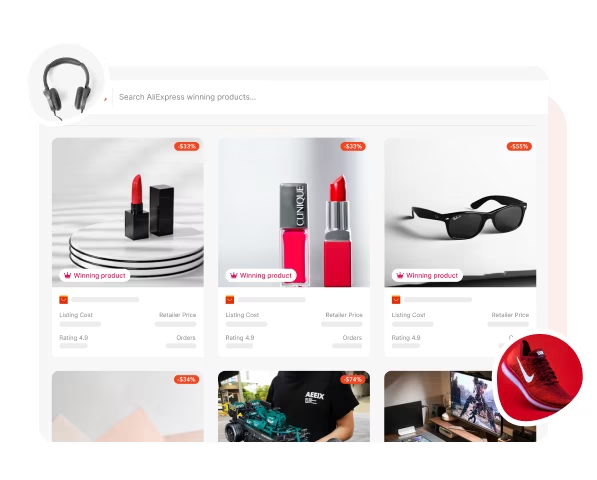
Plan details are on the AliDrop pricing page.
What happens if you don't pay the import charges
The carrier holds the parcel and sends you a payment request, usually by text or email with a link to its own site. In the UK, carriers normally hold parcels for about three weeks before returning them to the sender. Other countries work the same way with different deadlines. Once the parcel goes back, you generally lose the shipping cost, and AliExpress sellers often treat unpaid duties as the buyer's responsibility in disputes.
Watch out for scam messages too. Fake "customs fee" texts are common. Never pay through a link in a message; go to the carrier's site directly and enter your tracking number. Our guide to tracking AliExpress shipments shows how to find the real carrier and status.
The bottom line on AliExpress customs duties
Duty-free AliExpress orders are mostly gone. In the US every parcel is dutiable, in the EU every order pays VAT and cheap parcels now pay €3 per item, India charges 10% duty plus IGST, and only the UK still waives duty under £135, for now. Read the tax line on each listing, check the ships-from location, and do the math before you buy or list a product. If you sell to these markets, sourcing from local stock is the simplest way to keep prices honest. Start your 7-day trial for $1 to see which of your products already have US or EU suppliers.
AliExpress Import Tax and Customs Duties FAQs
Do I have to pay import tax on AliExpress orders in 2026?
In most countries, yes. The US has suspended its $800 de minimis exemption for all countries, the EU charges VAT on every import and a €3 per-item duty on parcels worth €150 or less, and India charges 10% duty plus IGST on personal imports. The UK charges VAT at checkout but no customs duty on non-excise goods worth £135 or less.
What does "Import charges will apply" mean on AliExpress?
It means the item ships from outside your customs area and duty will be due on top of the price. If an import charges line appears at checkout, AliExpress collects it up front and you shouldn't pay again on delivery. If no line appears, the carrier or postal service will ask you to pay before handing over the parcel.
Are AliExpress import charges included in the price?
Sometimes. In the EU and UK, VAT on low-value orders is included and shown as "Price includes VAT". Duty may be shown separately at checkout or billed later. Items marked "No import charges" or "Shipped locally" come from a warehouse inside your market, so there's nothing extra to pay at the border.
How much is the AliExpress customs duty in the US?
It depends on the product's tariff code and the additional tariffs in force on the day the parcel enters the US. CBP applies the HTSUS rate in effect at entry, and Chinese-made goods often carry extra Section 301 duties. Look up the code on the USITC Harmonized Tariff Schedule and check the checkout total for a duty line.
Does the EU €3 customs duty apply per parcel or per item?
Per item, where an item means goods sharing the same tariff classification. The European Commission's own example: five T-shirts in one parcel pay €3, while three T-shirts and a watch pay €6. It applies to parcels worth €150 or less from 1 July 2026 until 1 July 2028, whether or not VAT is handled through IOSS.
What is the customs duty on AliExpress orders to India?
Since 1 April 2026, basic customs duty on dutiable goods imported for personal use is 10%, down from 20%. IGST is then charged on the value plus that duty, at the product's GST rate. A ₹4,000 item in the 18% slab pays about ₹1,192 in total. Some specified goods are excluded from the lower rate.
What happens if I refuse to pay customs on an AliExpress order?
The carrier holds the parcel for a set period, about three weeks in the UK, and then returns it to the sender or disposes of it. You usually lose the shipping cost, and AliExpress disputes over unpaid duties rarely go in the buyer's favour, so decide quickly whether to pay or ask the seller for a solution.
Can I avoid AliExpress customs fees legally?
Yes, mainly by buying from local warehouses, which skip customs altogether. In the EU, grouping identical items into one parcel keeps the duty to one €3 charge, and in the UK staying under £135 per consignment avoids duty. Asking a seller to under-declare or label a purchase as a gift is customs fraud and can get the parcel seized.


%201.svg)


