

You sit down to write a product description. You know the product is great. You know customers would love it. But somehow, every description ends up sounding generic, boring, or just plain robotic . If that sounds familiar, you are not alone. Writing product descriptions that actually sell is hard work. You have to highlight features, address customer pain points, weave in SEO keywords, and maintain your brand voice—all while keeping it readable.
This is why so many online store owners now use AI tools to help. ChatGPT has become a go-to solution for generating product copy fast. But here is the catch: most people use it wrong. They type a lazy prompt, get lazy output, and blame the AI. In this guide, we will show you exactly how to use ChatGPT to write high-converting product descriptions. We will give you proven prompts, real examples, and also introduce you to smarter alternatives like Smartli that do even more for your e-commerce business.
Why Your Product Descriptions Matter More Than Ever in 2026?
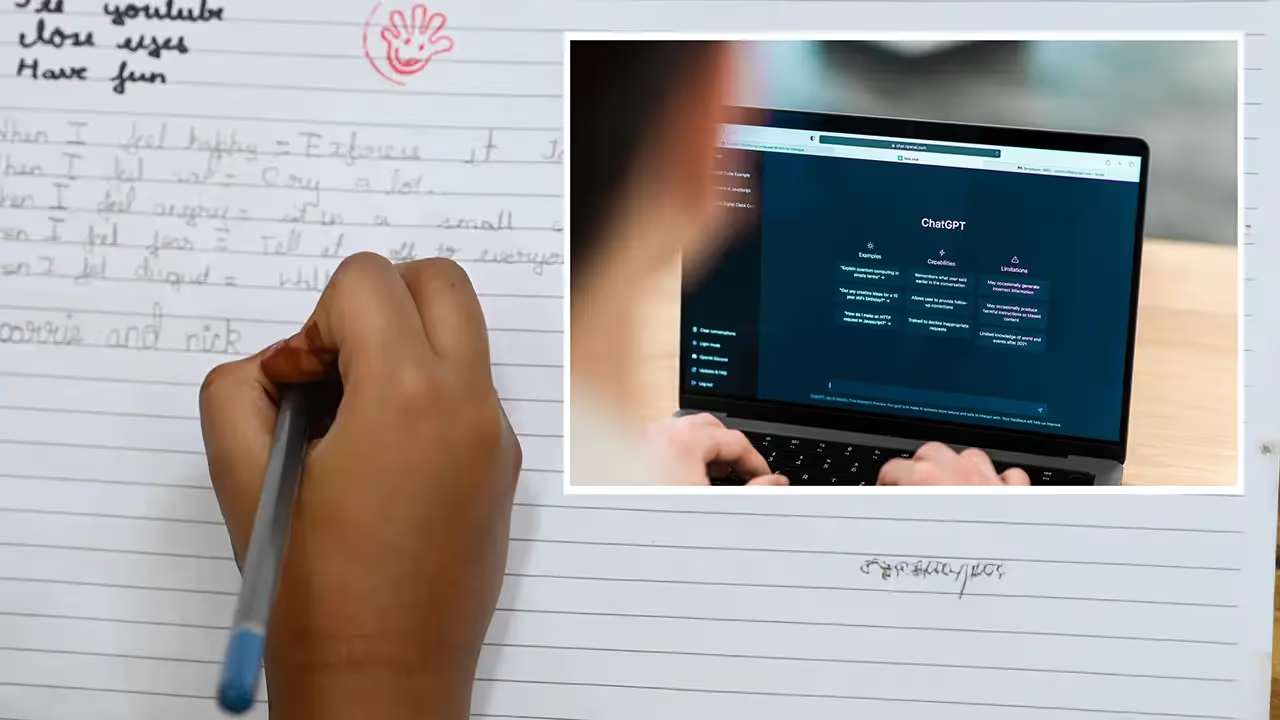
The e-commerce landscape has shifted. It is not just about ranking on Google anymore. In 2026, you also need to optimize for AI shopping agents like ChatGPT, Perplexity, and Claude. These platforms now drive a significant portion of product discovery, and they rely on detailed, structured product content to make recommendations .
If your product descriptions are thin or generic, AI agents will ignore you. You will lose sales before a human even sees your store. An AI product description generator helps you create the kind of rich, benefit-focused copy that both search engines and AI shopping assistants love. It solves the scale problem, too. Writing 500 descriptions manually takes over 100 hours. An AI tool can do it in minutes.
The Problem: Generic Prompts Produce Generic Output
Most people prompt ChatGPT like this:
"Write a product description for a smartwatch with heart rate monitoring and long battery life."
What do you get? Something bland. No personality, no emotional pull, no differentiation from the thousands of other smartwatches out there . The output sounds like it could apply to any product in any store. That kind of copy does not convert. You will need to spend more time editing it than you saved by using AI in the first place.
The difference between mediocre AI content and scroll-stopping copy comes down to one thing: how you structure your prompts . You need to give ChatGPT clear instructions, context, and constraints.
How to Write ChatGPT Prompts That Generate High-Converting Product Descriptions
Effective prompts are specific. They tell the AI who you are, who you are talking to, and what you want to achieve. Here are the essential rules.
1. Be Ridiculously Specific
ChatGPT is a pattern recognition machine. When you give it vague instructions, it gives you vague output. Specificity eliminates ambiguity.
Vague Prompt: Write an email about our new project management app.
Specific Prompt: Write a 150-word product launch email for a new project management app. Highlight these 3 features: AI-powered task prioritization, Slack integration, and a free 14-day trial. Tone: excited but professional, like you are telling a colleague about a tool that just solved your biggest headache. Include a clear CTA to start the trial .
The specific prompt gives the AI parameters to work within. It knows the word count, the features, the tone, and the goal. Your product descriptions need this same level of detail.
2. Assign a Professional Role
Starting your prompt with "You are a [specific role]" taps into ChatGPT's training on professional writing patterns. The model has learned associations between roles and writing styles.
Without Role: Write Instagram ad copy for a premium coffee subscription.
With Role: You are an experienced direct-response copywriter who specializes in Instagram ads for premium lifestyle brands. Write 3 versions of ad copy (each under 125 characters) for a premium coffee subscription service that emphasizes small-batch roasting and direct trade relationships.
The role-based prompt generates copy with strategy, not just enthusiasm.
3. Provide Examples of Your Brand Voice
This technique is called few-shot learning. You give ChatGPT examples of the output you want, and it mimics the pattern . If you have existing product descriptions that perform well, paste them into your prompt and ask for new copy in the same style.
Example Prompt: Write a product description for our new organic cotton bedsheets. Here are two examples of our brand voice from existing listings: [Paste Example 1] [Paste Example 2] Match this voice exactly. Focus on the softness of the fabric and the eco-friendly certification. Keep it under 100 words.
4. Specify What to Avoid
Large language models have repetitive writing patterns. You have probably seen the same overused phrases in AI content: "artisanal," "curated," "game-changing." You can tell ChatGPT exactly what words and phrases to skip .
Prompt with Constraints: Write a product description for a waterproof hiking backpack. DO NOT use these words: innovative, revolutionary, perfect, amazing. DO NOT use exclamation points. DO NOT exceed 120 words. Focus on: durability, comfort, and the specific compartments for gear.
This forces ChatGPT to find fresh ways to describe your product, making the copy sound less like generic AI slop and more like your brand.
10 Proven ChatGPT Prompts for Product Descriptions That Sell
Here are ready-to-use prompts for different scenarios. Replace the bracketed information with your own product details.
1. Benefit-Focused Description
Write a product description for [Product Name] that focuses on the top 3 benefits for [Target Audience]. List the key features as bullet points, but in the bullet points, explain what the user gains, not just the technical specs. Tone: [friendly/professional/luxury].
2. Problem-Solution Angle
Create a product description for [Product Name] that solves the problem of [Specific Pain Point]. Start by acknowledging the frustration your customer feels, then introduce the product as the solution. End with a soft call-to-action.
3. SEO-Optimized Description
Write an SEO-friendly, 150-word product description for [Product Name]. Incorporate these keywords naturally: [Keyword 1, Keyword 2, Keyword 3]. Aim the copy at [Target Audience]. Use short paragraphs and include a clear value proposition in the first sentence.
4. Storytelling Approach
Write a product description for [Product Name] that tells a short story about how it fits into a customer's daily routine. Focus on the emotional benefits and the transformation it provides. Tone: warm and relatable.
5. Comparison to Competitors
Write a product description for [Your Product] that positions it against [Competitor Product]. Address why customers might be considering the competitor, and give three reasons to choose your product instead. Do not bash the competitor; just highlight your unique advantages .
6. Targeted at a Specific Audience
Rewrite this existing description [paste description] to appeal to [New Target Audience, e.g., parents making baby food instead of fitness enthusiasts]. Keep the same features, but change how you talk about the speed settings and capacity .
7. Creating Urgency
Build a product description for our limited edition [Product Name] launching next month. Mention why it is special and explain why customers should buy now instead of waiting. Create a sense of scarcity without being pushy.
8. Technical Product (Jargon-Free)
Generate a product description for [Technical Product, e.g., waterproof hiking boots] that explains the [Technical Feature, e.g., Gore-Tex technology] without using jargon. Write for customers who are interested but not experts. Focus on what the feature does for them, not how it works .
9. Social Proof Focus
Write a product description for [Product Name] that incorporates social proof. Mention that [Number] of customers trust this product and include a short, fictional testimonial that highlights the main benefit. Tone: confident and trustworthy.
10. Multiple Variations for A/B Testing
Give me five different versions of a product description for [Product Name]. Each version should have a slightly different angle: one focused on price value, one on quality, one on convenience, one on style, and one on social proof. Keep each version under 100 words.
Beyond Text: Why You Might Need a Better Alternative
ChatGPT is a powerful tool, but it has limits. It only generates text. If you run an e-commerce store, you also need product images, ad creatives, and blog content. You might need to remove watermarks from supplier photos or generate model shots. This is where dedicated AI product description generator tools pull ahead.
Tools like Smartli offer a complete suite for e-commerce sellers. They combine AI copywriting with image editing capabilities, all in one dashboard. You can generate a product description, remove the background from a photo, and create a social media ad—without switching between five different apps.
Introducing Smartli: The All-in-One AI Tool for Writing
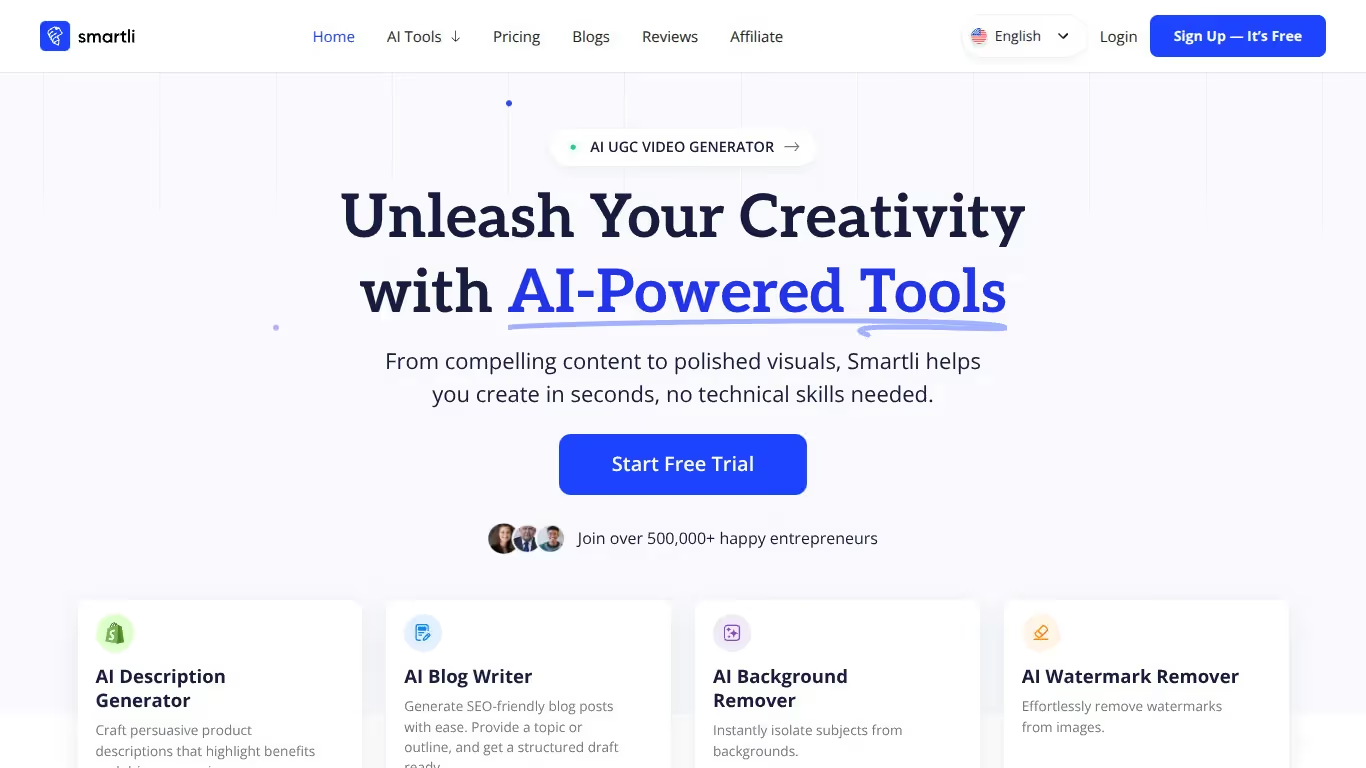
Smartli is an AI-powered platform designed specifically for online sellers. It helps you create product descriptions, blog posts, ad copy, and even edit images. If you are tired of juggling multiple subscriptions, Smartli consolidates everything into one affordable plan.
Smartli's Product Description Generator
The big feature is the product description generator. You enter your product details—title, features, keywords—and Smartli's AI creates SEO-friendly, benefit-focused copy in seconds. You can generate descriptions for hundreds of products at once, saving you weeks of work.
You can choose the tone of voice to match your brand, whether that is professional, casual, fun, or luxury. The AI adapts to your settings and produces clean, persuasive text that is ready to publish on Shopify, Amazon, or your own website.
Beyond Descriptions: Image Editing and Visuals
This is where Smartli differentiates itself from ChatGPT. Text is only half the battle. Your product photos need to look professional, too. Smartli includes a suite of image editing tools :
- Background Remover: Automatically removes backgrounds from product photos with precision.
- Watermark Remover: Eliminates logos and text overlays from supplier images while preserving original detail.
- AI Photo Enhancer: Boosts image quality instantly for professional-looking visuals.
- Model Photoshoots: Generates realistic on-model product images without expensive photography sessions.
- UGC Video Generator: Creates authentic user-generated style videos to fill your social media content gap.
Content Humanizer and Ads Writer
One common complaint about AI writing is that it sounds robotic. Smartli includes a Content Humanizer that transforms AI drafts into natural, engaging text that sounds like it came from a real person.
The Ads Writer helps you create platform-specific ad copy for Facebook, Instagram, Google, TikTok, and Pinterest. You can generate headlines, primary text, and descriptions tailored to each channel's requirements. If you’re looking for other humanizers, we recommend Walter Writes AI and Humanizer Pro, although they are not dedicated writing suites like Smartli.
How to Use Smartli
Getting started is simple. You sign up, connect your Shopify store (or import products manually), and start generating. You can create product descriptions, blog posts, and ad copy from the dashboard. Everything is editable, so you can add personal touches before publishing. The interface is designed for non-technical users, so you do not need a design or copywriting background to get professional results.
ChatGPT vs. Smartli: Which One Should You Use?
The right tool depends on your needs. Here is a quick comparison.
Use ChatGPT if:
- You need a free or low-cost option for generating text.
- You are comfortable with prompt engineering and manual editing.
- You only need to write product descriptions occasionally.
- You have separate tools for images and design.
Use Smartli if:
- You run an e-commerce store with many products.
- You need to generate descriptions in bulk.
- You also need image editing tools (background removal, watermark removal, enhancement).
- You want to create ad copy and blog posts in the same platform.
- You prefer an all-in-one solution with a simple interface .
Smartli's pricing stays under $100 monthly with a free trial available. For small business owners without design or copywriting backgrounds, it offers the quickest path from product data to published, professional-looking listings .
Writing CTAs That Convert with AI
A strong Call to Action (CTA) is the final push that turns a browser into a buyer. Your product description can be perfect, but if the CTA is weak, you lose the sale.
How to Prompt for Better CTAs
Use ChatGPT to generate multiple CTA options. Tell it the context and the action you want.
Prompt: Write 10 CTA variations for driving website clicks. Context: [describe post topic or product]. Goal: [read blog post, shop collection, download guide]. Tone: encouraging, not pushy .
Prompt for Scarcity: Write ad copy for a limited-time offer. Our promotion is [20% off for the next 48 hours]. Create a sense of urgency without sounding fake. Include a strong CTA .
Examples of Strong CTAs:
- "Get Results in 48 Hours" (speed/ease)
- "Only 5 Left in Stock—Add Yours Now" (scarcity)
- "Join 10,000 Happy Customers" (social proof)
- "Start Your Free Trial Today" (action-oriented)
CTAs work better when they match the content. Educational posts can ask for saves. Product posts can drive clicks. Good copy addresses objections, highlights benefits, and creates urgency.
Optimizing for Agentic Commerce: The Future of Product Discovery
We mentioned this earlier, but it is worth repeating. In 2026, you are writing for two audiences: humans and AI shopping agents. AI agents need structured, detailed content to recommend your products. A basic description will not cut it.
What AI Agents Look For
AI shopping assistants need to understand your product deeply. They look for :
- Detailed Specifications: Materials, dimensions, compatibility.
- Use Case Descriptions: Who the product is for and what problems it solves.
- Benefits Beyond Features: Why the product matters.
- Comparison Context: How it stacks up against alternatives.
When you use an AI product description generator, make sure the output is rich with this kind of information. Tools like Hypotenuse AI are designed with Generative Engine Optimization (GEO) in mind. They produce descriptions that AI agents can parse and recommend.
Structured Data Matters
Beyond the text itself, your website needs clean, structured data. Implementing Schema.org markup helps AI models understand your content. This includes labeling products, reviews, and prices in a language that AI can easily read . If you are using Smartli, you can export descriptions directly to your e-commerce platform, maintaining that structure.
Conclusion
Writing product descriptions that convert is no longer optional—it is essential for survival in e-commerce. With the rise of AI shopping agents and direct purchasing in chat interfaces, your product copy needs to work harder than ever.
ChatGPT is a great starting point. With well-structured prompts, you can generate solid copy fast. But if you want to go further, tools like Smartli offer a complete solution. You get AI-powered product descriptions, image editing, ad copy, and blog writing all in one place. It saves you time, money, and the headache of managing multiple subscriptions.
Stop staring at blank screens. Start using AI to write copy that sells. Try Smartli today and see the difference for yourself.
How to Use ChatGPT for Writing Product Descriptions FAQs
Can ChatGPT write SEO-friendly product descriptions?
Yes, ChatGPT can write SEO-friendly descriptions if you prompt it correctly. Include your target keywords in the prompt and ask for a specific word count. However, you should always review the output to ensure keywords appear naturally and the text remains readable. For bulk SEO needs, dedicated tools like Smartli automate this process.
What is the best AI product description generator for 2026?
The best tool depends on your needs. For an all-in-one solution with image editing, Smartli is a top choice. For enterprise-level bulk generation with platform integrations, Hypotenuse AI or Describely are strong options. For a free start, ChatGPT works, but you will need to invest time in prompt engineering.
How do I make ChatGPT sound like my brand voice?
You can train ChatGPT on your brand voice by using few-shot learning. Provide 2-3 examples of your best existing product descriptions in the prompt. Tell the AI to "match this voice exactly." Over time, you can save these instructions in a custom GPT or a prompt template for consistency.
Can Smartli generate descriptions for hundreds of products at once?
Yes, Smartli supports bulk generation. You can upload a CSV file with your product data, and the AI will create unique, SEO-optimized descriptions for every item. This feature saves e-commerce sellers weeks of manual work.
Is it legal to use AI-generated product descriptions?
Yes, using AI-generated content is legal. However, you should always review and edit the output. AI can sometimes produce inaccurate information or content that unintentionally resembles existing text. Adding your own edits ensures accuracy and protects your brand.
How do I write product descriptions that rank on ChatGPT Shopping?
To rank on ChatGPT Shopping (agentic commerce), you need detailed, structured product data. Include specifications, use cases, benefits, and comparison context. Optimize for both SEO and GEO by using natural language and clear formatting. Tools like Smartli are designed with this dual optimization in mind.


%201.svg)