


Most AliDrop reviews focus on features: product importing, automation, supplier access, Shopify integration, order fulfillment, and inventory syncing. These features matter, but they do not always answer the bigger question sellers have before signing up: what is AliDrop actually like after using it for a few months?
The first week with any dropshipping tool usually feels exciting. You explore the dashboard, import products, connect your store, and imagine how much time you could save. But after 90 days, the experience becomes more realistic. You know what works smoothly, what still needs manual attention, and whether the platform fits your store-building process.
AliDrop is built for sellers who want to start or scale AliExpress dropshipping with less manual work. It helps users import products, connect with Shopify, automate order tasks, sync inventory, and manage product listings more efficiently.
This honest breakdown looks at what users may notice after 90 days with AliDrop, including what they are likely to appreciate, where expectations need to stay realistic, and how to decide whether it is the right platform for your dropshipping business.
What is AliDrop?
AliDrop is a dropshipping platform designed to help ecommerce sellers source products, import listings, and automate parts of their AliExpress dropshipping workflow. Instead of manually copying product titles, descriptions, images, variants, and supplier details, users can bring products into their store faster and manage them from a more organized setup.

For Shopify sellers, AliDrop is especially useful because it supports store connection, product importing, inventory syncing, and order automation. This makes it easier to build a dropshipping catalog without handling every small task manually.
AliDrop can help sellers with:
- Importing AliExpress products
- Editing product listings
- Managing supplier products
- Automating order fulfillment
- Syncing inventory updates
- Connecting with Shopify
- Testing product ideas faster
- Reducing repetitive admin work
However, AliDrop is not a shortcut to guaranteed sales. Users still need to choose the right niche, validate products, improve product pages, run marketing campaigns, manage customer support, and build trust with buyers.
That is why 90-day reviews are useful. They show whether users understand AliDrop as a business tool, not a magic button. The platform can make dropshipping easier to manage, but the quality of results still depends on the seller’s strategy.
AliDrop Trustpilot Rating
AliDrop currently has a 4-star rating on Trustpilot, based on 1000+ customer reviews. This gives potential users a helpful third-party signal when comparing AliDrop with other dropshipping tools.
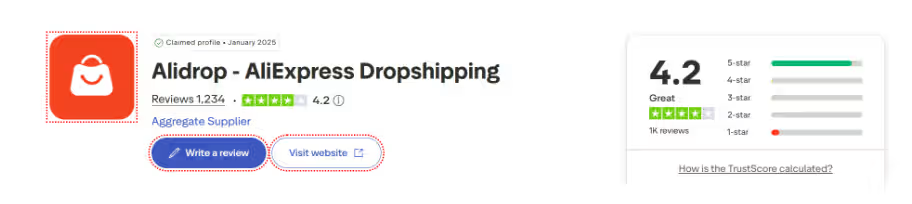
A strong Trustpilot presence can be useful because it shows that many users have already shared their experience publicly. Still, ratings should always be read with context. Some reviews may focus on setup, while others may discuss billing, support, fulfillment, or user expectations.
For a balanced view, sellers should look beyond the overall score and read recent reviews carefully. Pay attention to repeated themes. If many users mention time savings, product importing, or automation, that suggests clear strengths. If users mention confusion or expectations, that may show where beginners need better preparation.
A rating can help with trust, but it should not replace your own evaluation. The best way to judge AliDrop is to compare its features with your store goals, product strategy, and level of dropshipping experience.
What Users Notice in the First 30 Days
The first 30 days with AliDrop are usually about setup. Users connect their Shopify store, explore product importing, review supplier options, and start building their catalog. This is when the platform feels most useful for saving time.
For beginners, one of the biggest benefits is not having to create every product page from scratch. Manually adding AliExpress products can be slow. You need to copy titles, save images, write descriptions, add variants, adjust pricing, and organize products into collections. AliDrop helps reduce that repetitive work.
In the first month, users may notice:
- Faster product importing
- Easier store setup
- Less manual copying and pasting
- Quicker product testing
- More organized product management
- A smoother Shopify connection
However, this stage can also expose beginner mistakes. Some users import too many products too quickly. Because AliDrop makes importing easier, it can be tempting to fill the store with random items. That usually leads to a messy catalog and weak brand identity.
A better approach is to start with a focused niche. Import products that make sense together, rewrite product descriptions, choose clean images, and create collections that feel intentional.
After the first 30 days, users often realize that AliDrop helps with speed, but store quality still depends on how carefully they set things up.
What Users Notice After 60 Days
By day 60, users usually move from setup into testing. They start seeing which products get clicks, which pages attract interest, and which items are not worth keeping. This stage is where AliDrop becomes less about importing products and more about managing product experiments.
Users who test products regularly may appreciate how quickly they can adjust listings, add new products, remove weak items, and refine their catalog. Instead of spending hours on manual uploads, they can focus more on product selection, pricing, descriptions, and marketing angles.
After 60 days, users may notice:
- Faster product testing
- Easier catalog updates
- Less time spent on repetitive edits
- Better control over product listings
- More organized supplier-product workflows
- Useful support for order and inventory management
This is also when users become more selective. In the first month, they may import products because they look trendy. By the second month, they usually begin checking supplier reliability, shipping expectations, profit margins, product quality, and customer fit more carefully.
For example, a pet niche seller might import paw cleaners, travel bowls, grooming brushes, and car seat covers. After 60 days, they can review which products get the most attention and build the store around stronger performers.
AliDrop works best when users treat it as a testing assistant. It helps move faster, but the seller still needs to decide which products deserve attention.
What Users Notice After 90 Days
After 90 days, users usually have a clearer and more honest opinion of AliDrop. The excitement of trying a new tool has settled, and the real value comes down to whether the platform saves time, reduces manual work, and makes store management easier.
A 90-day user is likely to judge AliDrop based on practical questions:
- Did it make product importing easier?
- Did it reduce manual work?
- Did inventory syncing help?
- Did automation save time?
- Was order fulfillment easier to manage?
- Were supplier options useful?
- Did the workflow feel smoother than before?
- Did it help test products faster?
For many users, the biggest benefit after 90 days is operational efficiency. Dropshipping can become tiring when every product update, supplier check, order task, and tracking detail is handled manually. AliDrop helps reduce that workload.
Users may also find they have more time to focus on growth tasks, such as writing better product pages, testing ads, improving store design, building email flows, or researching new niches.
Still, 90 days also reveals what AliDrop cannot do. It cannot fix a weak niche, poor product selection, bad ads, unclear pricing, or a low-trust store. If the product offer is not strong, automation alone will not create consistent sales.
The users who are most satisfied after 90 days are usually the ones who use AliDrop with a focused strategy. They choose a niche, import selectively, edit listings properly, test products carefully, and use automation to support growth.
What Users Like About AliDrop
AliDrop’s biggest strength is that it helps reduce the busywork involved in AliExpress dropshipping. For sellers who want to move faster, that can make the business feel more manageable.
Faster Product Importing
One of the most common benefits users may notice is faster product importing. Instead of building listings manually, users can import product details and then customize them before publishing. This is especially helpful when testing multiple products.
Easier Shopify Workflow
AliDrop is useful for Shopify sellers who want a more direct way to connect product sourcing with store management. The ability to import, edit, and manage products from a connected workflow can save time.
Useful for Product Testing
Dropshipping depends on testing. AliDrop helps users test product ideas without buying inventory upfront. This makes it easier to explore niches and remove products that do not perform.
Automation Saves Time
Order fulfillment, tracking updates, and inventory syncing can become repetitive as order volume grows. Automation helps sellers reduce manual tasks and focus on improving the business.
More Supplier Flexibility
AliDrop gives sellers access to AliExpress dropshipping workflows and supplier options that can support different product categories. This is useful for sellers who want to compare products and build a more flexible catalog.
Overall, users who value speed, organization, and automation are more likely to find AliDrop useful.
What Users May Not Like About AliDrop
AliDrop can be helpful, but it is not perfect for every seller. Some complaints or frustrations often come from unrealistic expectations about what a dropshipping tool can do.
It Still Requires Work
AliDrop can help with importing, automation, and fulfillment workflows, but users still need to research products, write better descriptions, run ads, improve their store, and handle customers.
Imported Listings Need Editing
Supplier product titles and descriptions are often not ready for a polished store. Users should edit product copy, choose better images, adjust pricing, and make listings more customer-friendly before publishing.
Supplier Quality Still Matters
AliDrop can help with sourcing, but sellers still need to check product quality, supplier reliability, shipping expectations, and customer reviews. A poor product can still lead to refunds or complaints.
Beginners May Face a Learning Curve
New sellers may need time to understand Shopify, AliExpress, dropshipping margins, shipping expectations, and product validation. AliDrop simplifies parts of the process, but it does not remove the learning curve completely.
Too Many Products Can Hurt Focus
Because importing is easier, some users may add too many products. This can make the store feel random. A focused catalog usually performs better than a large collection of unrelated items.
These limitations do not make AliDrop weak. They simply show that the platform works best when users pair automation with strategy.
AliDrop Reviews After 90 Days: The Honest Breakdown
After 90 days, the most realistic AliDrop review is balanced. Users are likely to appreciate the time savings, product importing, automation features, and cleaner workflow. At the same time, they may also understand that AliDrop is not a substitute for product research, branding, or marketing.
A positive 90-day review might sound like this: AliDrop made it easier to add products, manage listings, and reduce manual dropshipping tasks. It helped the seller move faster and focus more on marketing and store improvements.
A more cautious 90-day review might sound like this: AliDrop is useful, but it does not guarantee sales. Sellers still need to choose the right products, check suppliers, improve product pages, and drive traffic.
Both perspectives can be true. AliDrop is valuable when used as an execution tool. It helps sellers act faster and manage tasks more efficiently. But it cannot replace the thinking behind a strong ecommerce business.
The best users after 90 days are usually those who understand the difference between automation and strategy. Automation saves time. Strategy decides where that time should go.
Who Is AliDrop Best For?
AliDrop is best for sellers who want to build or scale an AliExpress dropshipping store without doing everything manually. It is especially useful for people who are serious about testing products and improving their workflow.
AliDrop may be a good fit for:
- Beginners starting an AliExpress dropshipping store
- Shopify sellers who want faster product importing
- Store owners tired of manual product uploads
- Dropshippers testing multiple products
- Sellers who want automation support
- Users looking for supplier flexibility
- Ecommerce owners building niche stores
AliDrop may not be ideal for people who expect instant profit without learning ecommerce basics. It is also not the best fit for sellers who do not want to edit product listings, research products, or improve customer experience.
The platform is most useful when the seller has a clear goal. If you know your niche, understand your audience, and want to test products faster, AliDrop can support that process.
How to Get Better Results with AliDrop
The best way to use AliDrop is with a simple system. Do not import products randomly. Start with a niche, choose products carefully, and build a catalog that makes sense to customers.
To get better results:
- Choose a focused niche
- Import products selectively
- Rewrite product descriptions
- Check supplier reviews
- Review shipping expectations
- Set realistic pricing
- Test products before scaling
- Track product performance
- Remove weak products
- Improve product pages regularly
AliDrop can help you move faster, but quality control still matters. A clean product page, realistic shipping details, good images, and clear benefits can make a major difference in conversions.
Sellers should also avoid depending only on product importing. Growth comes from marketing, trust, customer experience, and product-market fit. AliDrop can support those efforts by reducing manual work, but the seller still needs to build the brand.
Final Verdict: Is AliDrop Worth It After 90 Days?
AliDrop can be worth it for sellers who want a faster, more organized way to run AliExpress dropshipping. After 90 days, users are most likely to value the platform for product importing, automation, Shopify workflow, inventory syncing, and reduced manual work.
It is especially useful for sellers who test products often or want to build a focused dropshipping catalog without spending hours on repetitive tasks. The platform can help users move faster from product idea to store listing.
However, AliDrop is not a guaranteed path to profit. It works best when paired with strong product research, reliable supplier checks, better product pages, realistic pricing, and consistent marketing.
The honest answer is this: AliDrop is a useful tool, but it is not the whole business. If you use it to support a clear dropshipping strategy, it can save time and make store management smoother. If you expect it to create sales without effort, you may be disappointed.
FAQs about Alidrop Reviews
Is AliDrop good for beginners?
Yes, AliDrop can be useful for beginners because it simplifies product importing, store connection, and parts of the dropshipping workflow. However, beginners still need to learn product research, pricing, marketing, and customer support.
What do users like most about AliDrop?
Users are likely to appreciate faster product importing, Shopify integration, automation features, inventory syncing, and reduced manual work. These features can make store management easier.
Does AliDrop guarantee sales?
No. AliDrop helps with operations, but sales depend on your niche, product quality, pricing, product pages, ads, traffic, and customer trust.
Is AliDrop only for AliExpress dropshipping?
AliDrop is mainly built around AliExpress dropshipping workflows, but it also supports broader sourcing and automation features that can help ecommerce sellers manage products and fulfillment more efficiently.
Is AliDrop worth it?
AliDrop can be worth it if you want to save time, import products faster, automate tasks, and manage your dropshipping workflow more efficiently. It is most valuable when used with a clear product and marketing strategy.


%201.svg)



%20(1).avif)
