

When you start building a dropshipping store, the first big fork in the road is picking the right automation tool. The market is crowded with options, each promising to simplify product sourcing, order fulfillment, and supplier management. Two names you will run into repeatedly are Dropified and Spocket. Both integrate with major e‑commerce platforms and both aim to save you from manual, time‑consuming tasks.
The challenge is that they solve the dropshipping puzzle in distinct ways. One leans hard into automation depth and multi‑platform reach. The other builds its foundation on a curated supplier network focused on fast shipping and brand presentation.
Your choice between them will influence where your products come from, how quickly they reach customers, and what you pay each month. This Dropified vs Spocket comparison breaks each platform into clear sections so you can see exactly what you get with either tool.
What Is Dropified?
.webp)
Dropified launched in 2015 and operates from Birmingham, Alabama. It is a cloud‑based automation platform that connects your online store to a wide range of product sources. Those sources include AliExpress, eBay, Alibaba, Amazon, Etsy, Walmart, and over 75 other websites.
Dropified does not function as a curated supplier directory. You bring your own suppliers or use the built‑in Chrome extension to scrape products from any site you choose. The platform then automates importing, inventory updates, pricing adjustments, and order fulfillment.
The core value of Dropified sits in its depth of automation and support for multiple stores. You can manage several storefronts from a single dashboard, apply custom pricing rules across product categories, and import existing product reviews to build social proof.
How Dropified Works?
You begin by installing the Dropified Chrome extension. While browsing AliExpress, eBay, Amazon, or any supported marketplace, you click the extension to pull product images, descriptions, and variants directly into your Dropified dashboard.
From there, you can edit images, remove backgrounds, rewrite descriptions, and adjust pricing before pushing the listing to your store. Dropified supports Shopify, WooCommerce, BigCommerce, CommerceHQ, and GrooveKart. The platform also lets you list products on Facebook Marketplace.
When an order comes in, Dropified automates the fulfillment process. You can process multiple orders at once without logging into separate supplier websites. The platform includes a captcha solver to smooth out AliExpress ordering and tools for bundling products from different suppliers in promotions.
Features Offered by Dropified
Dropified packs its automation into a set of features designed for sellers who want granular control.
- One‑click product imports: Pull products from over 75 supported websites using the Chrome extension.
- Automated price and inventory updates: Your store listings adjust automatically when supplier data changes.
- Custom pricing rules: Set markup parameters based on cost ranges or product categories.
- Order fulfillment automation: Process orders across AliExpress, eBay, and other sources without logging into each supplier account.
- Multi‑store management: Control up to three stores on the Essentials plan and more on higher tiers.
- Product review import: Bring existing product reviews into your store to build credibility.
- Captcha solver: Reduces friction when ordering from AliExpress.
- Social media advertising tools: Create ad campaigns directly from the platform.
- Product bundling: Combine items from different suppliers for promotional offers.
Dropified's automation depth makes it a strong candidate for sellers running multiple stores or managing large catalogs.
What Is Spocket?
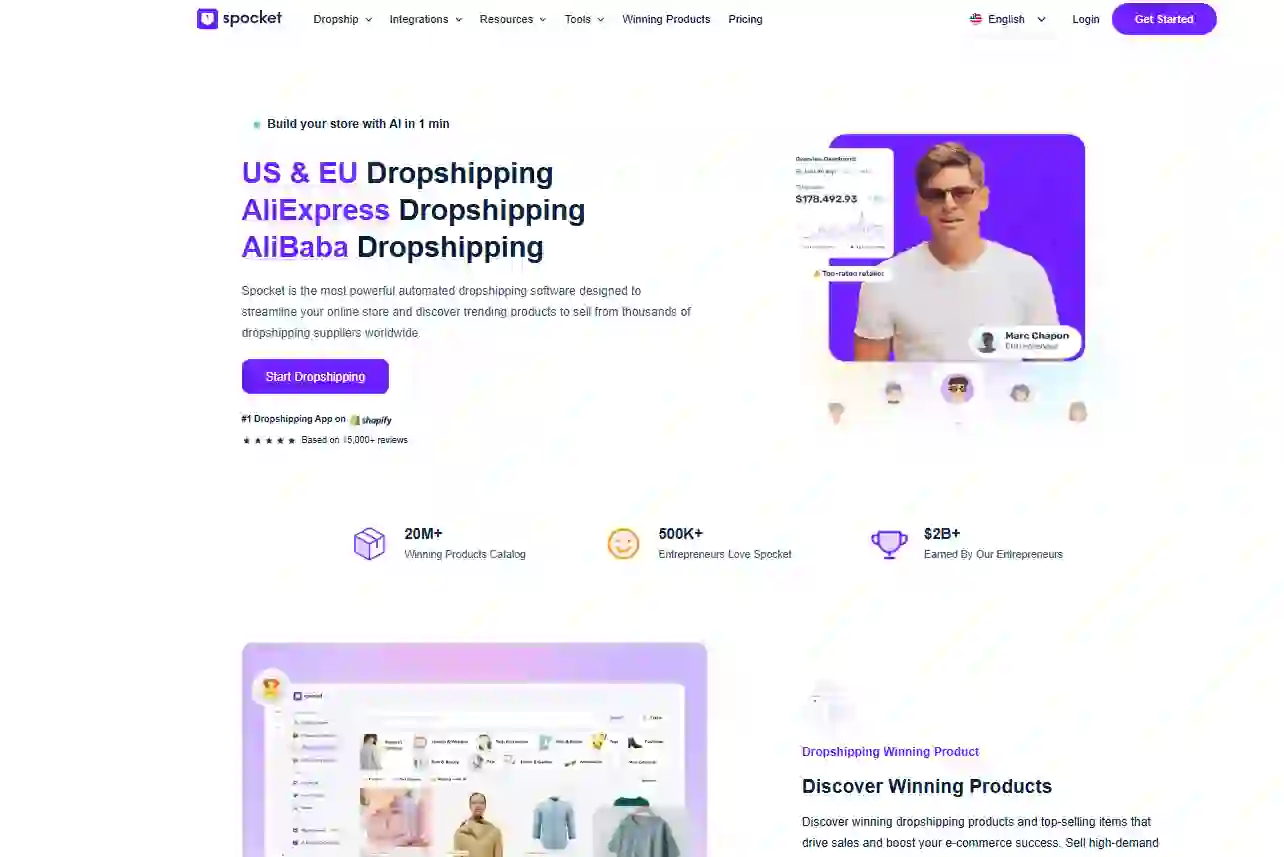
Spocket launched in 2017 as a curated supplier marketplace. You can sign up for Spocket and immediately access a managed database of over 100 million products. Instead of connecting you to any website you choose, Spocket connects you directly with wholesalers and manufacturers, most of whom are based in the United States and Europe.
The platform vets each supplier before they appear in the catalog. Spocket claims to accept fewer than 30% of supplier applications. That vetting process is meant to ensure reliable fulfillment and consistent product quality.
When you browse Spocket, you are looking at a managed database of over 100 million products. You filter by location, category, price, or shipping time and import items with one click. Spocket also supports dropshipping for organic non‑perishable foods, bakery items, beverages, and bath and beauty products.
How Spocket Works
You sign up for Spocket and immediately browse the product catalog. The platform shows you supplier location, shipping times, product cost, and suggested retail price. When you find an item you want to sell, you import it to your store with one click. Descriptions, images, and variants come over automatically.
When a customer places an order, Spocket forwards the details to the supplier. The supplier ships the product directly to your customer and uploads tracking information. Spocket syncs that tracking data back to your store dashboard.
Spocket integrates with Shopify, WooCommerce, BigCommerce, Wix, Squarespace, and eBay. The platform also offers a free basic plan and four paid tiers. A 7‑day free trial is available on paid plans. Spocket has no MOQs, so you can fulfill single‑unit orders and order samples before committing to sell a product.
Features Offered by Spocket
Spocket's feature set emphasizes simplicity, supplier reliability, and brand presentation.
- Curated supplier network: Over 80% of suppliers are based in the U.S. and Europe. Each supplier is vetted before listing.
- One‑click product imports: Pull descriptions, images, and variants into your store instantly.
- Real‑time inventory sync: Your store updates automatically when products go out of stock.
- Branded invoicing: Starting with the Professional plan, suppliers include your logo and business details on packing slips and invoices.
- AliScraper Chrome extension: Import products from AliExpress while keeping Spocket's automation benefits.
- Print‑on‑demand support: Sell customized apparel and accessories without holding inventory.
- Automated order fulfillment: Orders route to suppliers automatically with tracking synced back to your dashboard.
- No minimum order quantities: Fulfill single‑unit orders without supplier restrictions.
- Sample ordering: Test product quality before listing items in your store.
- AI store generator (DropGenius): Launch a store and stock it with trending dropshipping products from the Spocket catalog.
- AI logo generator (Logome): Create brand visuals directly within the Spocket ecosystem.
- Cross‑selling support: Pair complementary products to increase average cart value.
Spocket also offers a wide product range across categories like tech, wellness, and eco items, home decor, pet supplies, and beauty products including Korean skincare, organic facials, and cruelty‑free personal care.
Spocket vs Dropified: Pricing
Pricing structures differ enough that a Spocket vs Dropified pricing comparison requires looking at both monthly and annual options.
Spocket Monthly Pricing (No Annual Commitment)
- Starter: $39.99 per month
- Professional: $59.99 per month
- Empire: $99.99 per month
- Unicorn: $299.99 per month
Spocket Annual Pricing (Billed Yearly)
- Professional: $24 per month (save $432)
- Empire: $57 per month (save $516)
- Unicorn: $79 per month (save $2563)
Spocket offers a free basic plan with limited functionality. The Starter plan is monthly only. Annual plans include a 7‑day free trial.
Dropified Monthly Pricing
- First Flight: $27 per month (unlimited orders, up to 150 products, $30 Alibaba credit)
- Essentials: $47 per month (up to three stores, up to 5,000 products, five team members)
- AI Plan: normally $197 per month, currently offered at $47 per month
Dropified does not offer a free tier beyond the 14‑day free trial on paid plans. Product limits on the First Flight plan cap at 150 items, while higher tiers offer unlimited products.
The Dropified vs Spocket pricing decision depends on whether you pay monthly or commit annually. Dropified's entry‑level monthly cost is lower, but Spocket's annual discounts bring comparable plans into competitive range.
Dropified vs Spocket: Shipping, Returns, and Handling
Shipping speed is the most noticeable difference in a Dropified vs Spocket comparison.
Spocket's supplier network, with over 80% of partners based in the U.S. and Europe, delivers products to domestic customers in two to five days on average. Faster shipping lowers chargeback risk, reduces refund requests, and encourages repeat purchases.
Spocket maintains a policy of no minimum order quantities. You can fulfill single‑unit orders and order samples to verify product quality before listing an item. Returns and handling follow each supplier's individual policy, but Spocket's vetting process surfaces suppliers with reasonable return windows and responsive communication.
Dropified's shipping experience depends entirely on the supplier you select. If you source from U.S.‑based sellers on eBay or Amazon, shipping times can be competitive. If you rely on AliExpress, you accept the standard multi‑week delivery windows. Dropified automates the ordering process but does not control or influence shipping speed.
Print‑on‑Demand Services: Spocket vs Dropified
Spocket includes print‑on‑demand support as a native feature. You can sell customized apparel, accessories, and home goods without holding inventory. Suppliers print and ship items directly to customers with your branding included on packing slips and invoices.
Dropified does not offer built‑in print‑on‑demand services. The platform connects to external marketplaces, so you could source print‑on‑demand products from other providers and manage them through Dropified's automation tools. However, there is no direct print‑on‑demand supplier network inside the Dropified dashboard.
For sellers focused on custom merchandise and branded dropshipping, Spocket provides a more integrated solution.
Finding Trending Dropshipping Products: Spocket vs Dropified
Spocket surfaces trending dropshipping products directly within its curated catalog. The platform highlights items gaining traction across its user base and includes a dedicated section for trending products. You can filter by category, location, and shipping time to narrow your search.
Dropified does not curate its own product catalog. It gives you access to whatever is available on the marketplaces it connects to. Finding trending products requires external research, using tools like Google Trends or Amazon Best Sellers. Dropified's automation then helps you import and manage those products once identified.
The Dropified vs Spocket app distinction here is clear. Spocket gives you a managed, searchable catalog with built‑in trend detection. Dropified gives you the freedom to source from anywhere but leaves trend research in your hands.
Dropified vs Spocket: What Users Online Are Saying
User sentiment around both platforms reveals consistent patterns.
Spocket users frequently praise the platform for fast shipping times, responsive 24/7 chat support, and the quality of U.S. and E.U. suppliers. The branded invoicing feature receives positive mentions from sellers building long‑term brands. Some users note that product pricing can be higher than AliExpress alternatives, which affects profit margins.
Dropified users highlight the platform's automation depth, multi‑store management, and unlimited product capacity on higher plans. The ability to source from over 75 websites gives sellers flexibility. Common criticisms mention customer support availability being limited to standard business hours and a steeper learning curve for new users.
Both platforms have active user communities and offer educational resources. Spocket includes Spocket Academy with courses from successful sellers like Marc Chapon, who generated $178,492 in three months dropshipping U.S. and European products. Dropified provides documentation, webinars, and a blog with operational guidance.
How to Choose Between Dropified and Spocket?
The decision between Dropified vs Spocket hinges on your business model, target audience, and operational preferences.
1. Supplier Location and Shipping Speed
If your customers are primarily in the U.S. or Europe and you want delivery windows of two to five days, Spocket is the stronger choice. Its curated supplier network removes guesswork around reliability and shipping times. If you are comfortable sourcing from AliExpress or other international marketplaces and can manage longer delivery expectations, Dropified offers more flexibility.
2. Product Volume and Catalog Scope
If you plan to list hundreds or thousands of products across multiple stores, Dropified's unlimited product allowance and multi‑store support are valuable. Spocket's tiered product limits (25 on Starter, 250 on Professional, 10,000 on Empire, 25,000 on Unicorn) may constrain larger catalogs unless you upgrade.
3. Automation Depth and Control
Dropified gives you granular control over pricing rules, inventory updates, and fulfillment workflows. Sellers who want to automate complex operations across several platforms will find Dropified's feature set aligned with their needs. Spocket's automation is simpler and more streamlined, which makes it easier for beginners.
4. Branding and Presentation
Spocket's branded invoicing helps create a professional, cohesive customer experience. If brand identity and repeat business are priorities, this feature adds tangible value. Dropified allows product customization but does not match Spocket's branded packing slip capabilities.
5. Budget and Billing Preferences
Monthly pricing without commitment favors Dropified at the entry level. Spocket's annual discounts narrow the gap considerably. If you prefer to pay month‑to‑month, Dropified starts at $27 per month. If you can commit annually, Spocket's Professional plan at $24 per month becomes compelling.
6. Integration Needs
Both platforms support Shopify, WooCommerce, and BigCommerce. Spocket adds Wix and Squarespace. Dropified adds CommerceHQ, GrooveKart, and Facebook Marketplace.
7. Print‑on‑Demand Requirements
If custom merchandise and branded packaging are central to your business, Spocket's built‑in print‑on‑demand support gives it an edge. Dropified requires external POD providers and additional management.
You could also consider Alidrop as an alternative if AliExpress dropshipping is central to your strategy. Alidrop automates AliExpress sourcing and connects you with Temu and Alibaba suppliers. It offers a 7‑day free trial, 24/7 VIP customer support, and an AI Shopify Store builder that stocks your store with trending products. The platform includes an AI Product Description Writer for creating SEO‑optimized listings. You can source products from US and EU suppliers worldwide and integrate with eBay, Shopify, Amazon, and other major platforms. The Alidrop marketplace helps you identify winning products and track current trends.
Top Mistakes to Avoid When Choosing a Dropshipping App
Here are top mistakes to avoid when choosing a dropshipping app:
- Overlooking shipping times in your target market: A product that takes three weeks to arrive generates more refund requests and negative reviews than a similar item that arrives in four days. Match your supplier network to your customer base.
- Choosing a plan based solely on monthly price: Annual billing on Spocket cuts costs significantly. If you intend to use the platform for a year, the monthly comparison becomes less relevant.
- Ignoring product limits until you hit them: Spocket's Starter plan caps you at 25 unique products. If you plan to test dozens of items or run a broad catalog, you will need to upgrade quickly.
- Assuming all automation tools work the same way: Dropified's automation is deeper and more configurable. Spocket's automation is simpler and more accessible. Choose based on your comfort level and operational needs.
- Neglecting branded invoicing for long‑term brand building: A packing slip with your logo reinforces brand recognition. A generic supplier invoice does the opposite.
- Underestimating the value of supplier vetting: Researching and verifying suppliers takes time and carries risk. Spocket does this work upfront. Dropified puts the responsibility on you.
- Forgetting to check integration compatibility: Confirm that the app works with your existing e‑commerce platform before signing up.
Conclusion
The right tool depends on what you are selling, where your customers live, and how much control you want over your supply chain. One platform prioritizes fast shipping and brand presentation through a curated supplier network. The other emphasizes automation depth and multi‑platform flexibility with unlimited product capacity. Your choice should reflect your operational priorities and customer expectations.
If fast, reliable shipping and a streamlined experience matter most, test the curated marketplace first. If you need advanced automation and plan to manage multiple stores with large catalogs, the automation‑focused platform offers the tools to handle that workload. Many sellers end up using both at different stages.
Dropified vs Spocket FAQs
Does Spocket have a free plan?
Yes. Spocket offers a free basic plan with limited functionality. You can browse products and test the platform before committing to a paid tier. Paid plans include a 7‑day free trial for new users.
Does Dropified offer a free trial?
Yes. Dropified provides a 14‑day free trial on paid plans. The platform does not have a permanently free tier beyond the trial period. You can test features and decide whether to continue.
Which dropshipping app has better shipping times?
Spocket offers faster shipping because over 80% of its suppliers are based in the U.S. and Europe. Delivery typically takes two to five days. Dropified's shipping times depend on the supplier you choose.
What is the difference in product limits between the two apps?
Spocket limits unique products based on your subscription tier, ranging from 25 products on Starter to 25,000 on Unicorn. Dropified does not enforce product limits on paid plans.
Which app integrates with more e‑commerce platforms?
Dropified integrates with Shopify, WooCommerce, BigCommerce, CommerceHQ, GrooveKart, and Facebook Marketplace. Spocket integrates with Shopify, WooCommerce, BigCommerce, Wix, and Squarespace.
Is branded invoicing available on both platforms?
Spocket includes branded invoicing on Professional plans and above. Suppliers can include your logo on packing slips. Dropified allows product customization but does not offer branded invoicing.


%201.svg)