

If you have typed "dropshipping meaning" into Google and landed on five different definitions that all sound like they were written for a business school exam, you are not alone. Most explanations either oversimplify it into "sell stuff without buying stuff" or bury you in jargon before you even understand who does what.
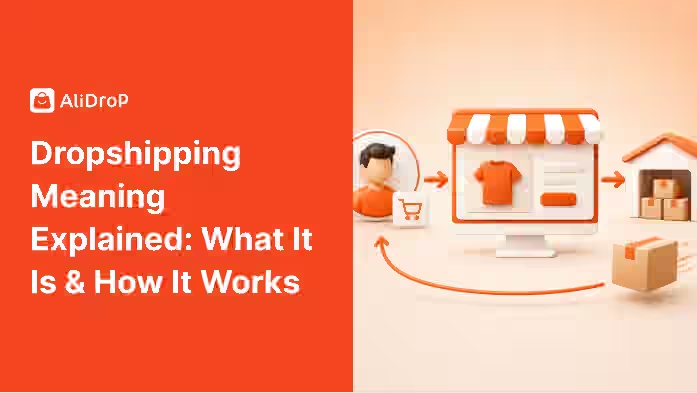
Here is the short version. Dropshipping means you sell a product on your own online store, but you never touch, store, or ship it yourself. When someone buys from you, you forward that order to a supplier, who packs it and ships it directly to your customer. You collect the sale price, pay the supplier its (lower) cost, and keep the difference as profit.
That is the whole model in one paragraph. Everything below breaks down how it actually works in practice, whether it is legal and profitable in 2026, and how you can start one yourself without getting stuck on the technical parts.
What Does Dropshipping Mean?
Before getting into steps and examples, it helps to nail down the definition itself, since this is the part most beginners get confused about first.
Dropshipping Meaning Explained
Dropshipping is a retail fulfillment method where a store owner sells products to customers without ever holding physical inventory. Instead of buying stock upfront, you list items from a supplier's catalog on your store, and the supplier ships each order directly to the buyer once you forward it to them.
This is different from traditional retail, where you buy in bulk, store it in a warehouse, and ship it yourself. In dropshipping, the product never passes through your hands. Your job is running the storefront, marketing, and customer service. The supplier's job is manufacturing, warehousing, and shipping.
.avif)
The Three Parties Involved
Every dropshipping transaction has the same three players, and understanding their roles makes the whole model click faster:
- You (the store owner): You choose products, set your own retail price, run the marketing, and handle customer support. You never see or touch the physical item.
- The customer: They browse your store, pay you directly, and receive the product at their door. Most customers do not know a supplier is involved at all.
- The supplier: A manufacturer or wholesaler who keeps the actual inventory, packs each order, and ships it to your customer once you place the order on their end.
How Does Dropshipping Work? (Step-by-Step)
Now that the definition is clear, here is what actually happens behind the scenes every time someone buys from a dropshipping store.
The process follows the same five steps regardless of whether you are sourcing from AliExpress, a US supplier, or a wholesale catalog:
- A customer places an order on your online store and pays you the retail price you set.
- You forward that order to your supplier, either manually or through an automation tool, and pay the supplier's wholesale cost.
- The supplier packs the item using their own inventory, since they are the ones physically holding stock.
- The supplier ships it directly to your customer, usually under your store's branding if you are using a branded dropshipping setup.
- You keep the difference between what the customer paid you and what you paid the supplier as your profit.
Steps two and three are where most beginners either burn hours doing it by hand or use software like AliDrop to auto-forward orders and sync tracking numbers the moment a sale comes in.
A Real Dropshipping Example
Numbers make this easier to picture than another abstract explanation, so here is a simple walkthrough using an actual product.
Say you are selling a phone charging stand on your Shopify store. Your supplier lists it for $6, and you price it at $19.99 on your store. A customer buys it and pays you $19.99. You then place the same order with your supplier for $6, and they ship it straight to the customer's address. You never see the physical stand. Your profit on that single order is $13.99, minus whatever you spent on ads or platform fees to get that sale in the first place.
Scale that across fifty or a hundred orders a day, and you start to see why dropshipping appeals to people who want to test products without sinking money into a warehouse full of stock they might not sell.
Dropshipping vs. Wholesaling vs. Traditional Retail
A lot of the confusion around dropshipping meaning comes from mixing it up with similar-sounding business models, so it is worth putting them side by side.
The core difference is inventory risk. With wholesaling and traditional retail, you pay for stock before you know it will sell. With dropshipping, you only pay for a product after a customer has already paid you, which is why it is often described as a low-risk way to start an online business.
Is Dropshipping Legal?
“Is Dropshipping Legal” is one of the most searched questions about dropshipping, and the short answer is yes, it is a completely legal business model.
Dropshipping is legal in the United States and most countries worldwide. Major platforms including Shopify, Amazon, and eBay explicitly allow it, and it is used by millions of online sellers every year. That said, legality comes with a few conditions you need to actually follow:
- Register your business the same way you would any other online business, since operating without proper registration can create tax issues later.
- Disclose accurate shipping times, especially if products are coming from overseas suppliers, since misleading customers about delivery windows can trigger consumer protection complaints.
- Avoid trademarked or counterfeit products, since reselling branded items without authorization is where dropshippers actually run into legal trouble, not the model itself.
- Follow your selling platform's specific policies, since Amazon, for instance, requires you to be the seller of record on all packaging and invoices.
The model itself is not the problem. Most legal issues in dropshipping come from what people choose to sell or how they handle customer communication, not from dropshipping as a concept.
Is Dropshipping Profitable? Realistic Numbers for 2026
Profitability is where a lot of dropshipping content gets either overly hyped or overly negative, so here are the numbers as they actually stand today.
The global dropshipping market is valued at approximately $583.5 billion in 2026 and is projected to keep growing at a 20.7% compound annual growth rate through 2033, according to Grand View Research. That scale tells you the model is far from a fad, but market size and individual profitability are two different things.
On the seller side, most dropshippers operate with a net profit margin between 15% and 20% after accounting for product cost, shipping, advertising, and platform fees, based on data from SellersCommerce. High-performing stores with strong branding and repeat customers can push margins closer to 30%, while stores still testing products or running inefficient ad campaigns often fall below 10%.
In plain terms: dropshipping can be profitable, but it is not passive income. Your margin depends heavily on your niche, how well you control ad spend, and whether you are automating the repetitive parts of order fulfillment instead of eating into your own time doing it manually.
Dropshipping Pros and Cons at a Glance
You do not need an exhaustive list here, just enough to know what you are signing up for before committing time and money.
What works in its favor:
- Low startup cost since you are not buying inventory upfront
- Easy to test multiple products or niches without financial risk
- Location independent, since you can run it from anywhere with an internet connection
What to watch out for:
- Thinner profit margins compared to buying in bulk
- Less control over shipping times and product quality, since suppliers handle both
- Higher competition in popular niches, since the barrier to entry is low for everyone
For a full breakdown of every advantage and trade-off, including how they play out over a real store's first year, our detailed dropshipping pros and cons guide covers each point in depth.
Types of Dropshipping Business Models
"Dropshipping" is often used as a catch-all term, but it actually branches into a few distinct approaches depending on where products come from and how they are branded.
- AliExpress dropshipping: The most common entry point, where you source products directly from AliExpress sellers and ship internationally. Our complete AliExpress dropshipping guide walks through how this works in 2026 specifically.
- Branded dropshipping: You work with suppliers who ship products in your own packaging and branding, rather than generic boxes, which helps build repeat customers and brand recognition.
- Print on demand: Products like t-shirts, mugs, and posters are printed with your design only after a customer orders, combining dropshipping's no-inventory model with custom merchandise.
- US and EU supplier dropshipping: Instead of sourcing from overseas, you partner with domestic or regional suppliers for faster shipping times, usually at a slightly higher product cost.
Most beginners start with AliExpress dropshipping because of the sheer product variety and low entry cost, then move toward branded or US and EU suppliers as their store grows and customers start expecting faster delivery.
How to Start Dropshipping as a Complete Beginner
Understanding the meaning and mechanics is one thing, actually starting is where most people get stuck on decision paralysis. Here is the process broken into steps you can follow in order.
- Pick a niche you can commit to. Choose a product category with genuine demand, not just something trending for a week. Broad interest with room for a specific angle tends to outperform ultra-narrow micro-niches.
- Set up your online store. Shopify remains the most common platform for dropshipping because of how easily it connects with sourcing and automation apps.
- Find a reliable supplier. Look for suppliers with consistent shipping times, decent reviews, and responsive communication, since your entire customer experience depends on their reliability.
- Import products and set your pricing. Add products to your store with pricing that covers your costs plus a sustainable margin, not just what looks competitive on the surface.
- Automate order fulfillment. This is the step most beginners underestimate. Manually copying orders, addresses, and tracking numbers for every sale does not scale past a handful of orders a day.
For a full, ground-up walkthrough covering niche selection, store setup, and marketing in detail, our complete beginner's dropshipping guide goes deeper into each stage.
The Easiest Way to Start: AliDrop vs. Manual Dropshipping vs. Spocket
Step five above, automating fulfillment, is exactly where most beginners either lose hours every week or hand that work off to software. Here is how the main options actually compare.
AliDrop is built specifically for sellers who want the product range of AliExpress, Alibaba, and Temu without giving up automation, syncing your inventory, orders, and tracking so you are not doing it order by order like the manual route above.
To be upfront about the trade-offs: AliDrop's subscription auto-renews and cancellation needs to be done before your renewal date, and product pricing does not sync automatically in real time, so it is worth checking supplier prices periodically rather than assuming your listed price always matches. Neither of these is unusual for the category, but you should know them going in.
If you want to see the full setup in action, start your 7-day trial with AliDrop and cancel any time if it is not the right fit.
Common Beginner Mistakes to Avoid
Most failed dropshipping attempts do not fail because of the business model itself, they fail because of a handful of repeatable mistakes.
- Picking a saturated product with no differentiation. If ten other stores are selling the exact same item with the exact same photos, price becomes the only competitive lever, and that rarely ends well.
- Ignoring shipping times during product selection. A great product with a four-week delivery window will generate refund requests faster than sales.
- Skipping supplier vetting. Order a sample yourself before listing a product at scale, since reviews and order counts do not always reflect current supplier reliability.
- Treating it as fully passive. Customer service, ad management, and monitoring supplier performance all require ongoing attention, even with automation handling fulfillment.
Start Your Dropshipping Store the Easier Way
Dropshipping, at its core, is a straightforward idea: sell products you never have to store, ship, or touch yourself. The part that actually determines whether it works for you is execution, picking the right products, working with reliable suppliers, and not losing hours every week to manual order entry.
If you are ready to move past the definition and into actually building a store, AliDrop gives you access to AliExpress, Alibaba, and Temu products alongside vetted US and EU suppliers, with automated order fulfillment built in from day one. Start your 7-day free trial and cancel any time.
Dropshipping Meaning FAQs
Is dropshipping legal?
Yes. Dropshipping is a legal business model used by millions of sellers worldwide and is explicitly permitted by platforms like Shopify, Amazon, and eBay. You do need to register your business properly, disclose accurate shipping information, and avoid selling counterfeit or trademarked products without authorization.
What is an example of dropshipping?
A common example is selling a $6 supplier-sourced item on your store for $19.99. When a customer buys it, you pay the supplier $6, they ship it directly to your customer, and you keep the $13.99 difference as profit, minus any advertising costs.
Is Amazon a dropshipper?
No, Amazon itself is not a dropshipper. However, individual third-party sellers on Amazon can use dropshipping as their fulfillment method, provided they follow Amazon's policy of being the seller of record on all packaging, invoices, and customer communication.
How do I become a dropshipper?
You become a dropshipper by setting up an online store, partnering with a supplier, listing their products at your own retail price, and forwarding customer orders to that supplier for fulfillment. Most beginners start on Shopify with a sourcing and automation tool like AliDrop to handle imports and order forwarding.
Is dropshipping worth it for beginners?
It can be, especially because the low upfront cost lets you test products and niches without the financial risk of buying inventory. That said, it requires consistent effort in marketing, customer service, and supplier management, so it is not a passive income shortcut.
Is $100 enough to start dropshipping?
It is possible to launch with a budget close to $100 if you use a free trial for your sourcing tool and keep initial ad spend minimal, but most sellers find that a slightly larger starting budget, closer to a few hundred dollars for ads and platform fees, gives more realistic room to test what actually sells.
What is the difference between dropshipping and wholesaling?
Dropshipping means you never hold inventory and only pay a supplier after a customer has already paid you. Wholesaling means you buy products in bulk upfront, at a discounted rate, and store them yourself before reselling, which requires more capital but usually comes with better margins per unit


%201.svg)