

If you have ever wondered how someone sells a product online without ever touching it, you are asking the right question. Dropshipping works by letting you sell products through your own online store while a third-party supplier handles the storage, packing, and shipping for every order. You never hold inventory. You never pack a box. Your job is to find good products, run a store people trust, and manage the customer relationship. The supplier does the rest.
It sounds almost too simple, and that is exactly why so many people get the mechanics wrong. Below, we will walk through the entire process step by step, show you exactly who is involved at each stage, and be honest about where the model gets hard so you know what you are actually signing up for.
What is Dropshipping?
Dropshipping is an order fulfillment method where your store never physically stocks the products it sells. When someone buys from you, that order gets forwarded to a supplier who ships it directly to your customer under your branding.
That one sentence answers "what is dropshipping and how does it work" for most people, but the real value is in the details of how that handoff actually happens, which is what the rest of this guide covers. If you are earlier in your research and want the full breakdown of sourcing trustworthy suppliers, our guide on importing from vetted US and EU suppliers is a good next stop.
The Dropshipping Process: Step by Step Guide
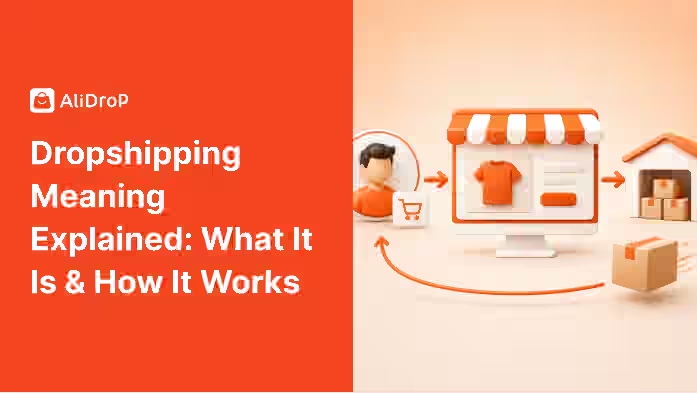
Here is the part most articles gloss over. Dropshipping is not one action, it is a short chain of handoffs between three parties, and understanding each link makes the whole model click.
.avif)
Step 1: A Customer Places an Order on Your Store
Your storefront, whether it is on Shopify or another platform, looks and functions like any other online shop. The customer browses, adds a product to their cart, and checks out using your payment gateway. At this point, you already have their money. This is the detail that trips people up: you collect the retail price first, before you ever pay the supplier a cent.
Step 2: Your Store Sends the Order Details to the Supplier
This is the handoff moment. Your store needs to notify the supplier that an order came in, including the product, quantity, and the customer's shipping address. Done manually, this means logging into a supplier dashboard and copying details over by hand for every single sale, which does not scale past a handful of orders a day. This is exactly where automation tools like AliDrop's order routing remove the manual work by pushing order details to the supplier the moment a sale happens.
Step 3: The Supplier Packs and Ships Directly to the Customer
The supplier, not you, picks the item off their shelf, boxes it, and ships it straight to your customer's door. Your business name and branding typically appear on the packing slip or invoice, not the supplier's. The customer has no idea a third party fulfilled the order, and honestly, they should not need to.
Step 4: You Keep the Retail Markup
You paid the supplier their wholesale or cost price. Your customer paid you the retail price. The difference is your profit, and it is collected without you ever fronting money for inventory. As a simple illustration, if a supplier charges $2 for a product and you sell it for $8, your profit on that sale is $6, before accounting for ad spend, platform fees, and returns.
Step 5: Customer Service Stays With You, Not the Supplier
This is the step people underestimate the most. If a product arrives damaged or late, your customer emails you, not the supplier. You are the face of the business at every stage after checkout, which means your supplier relationship and your support process need to be genuinely reliable, not an afterthought.
Who's Involved in a Dropshipping Order
Every dropshipping transaction runs through the same three parties, and knowing exactly what each one does removes most of the confusion beginners have.
- The retailer (you). You run the storefront, set retail pricing, handle marketing, and own the customer relationship from click to delivery.
- The supplier. A manufacturer or wholesaler who holds the actual inventory and ships it out under your brand. This could be an AliExpress or Alibaba supplier, a Temu seller, or a vetted US or EU-based supplier.
- The automation layer. A dropshipping app like AliDrop sits between your store and your suppliers, syncing product data, routing orders, and keeping tracking information updated so you are not doing any of that by hand.
This is the dropshipping business model at its core: a lean structure where you control the brand and the customer experience while suppliers and software handle logistics.
How Dropshippers Actually Make Money
The math behind dropshipping profit is simple on paper: retail price minus supplier cost equals your margin. What is less simple is protecting that margin once advertising, platform fees, returns, and currency shifts are factored in.
Industry benchmarks put typical dropshipping profit margins somewhere in the 15 to 30 percent range before ad spend. That range explains why product selection and supplier pricing matter so much. A five-dollar margin on a slow-moving product will not survive paid ad costs, while a well-priced product with a loyal repeat-customer base can be genuinely profitable.
A few things that quietly eat into dropshipping margins:
- Payment processing fees on every transaction
- Ad spend to acquire each customer
- Refunds and return shipping when suppliers do not accept returns
- Currency conversion costs on international supplier payments
None of this means the model does not work. It means the sellers who succeed treat margin protection as a daily discipline, not an afterthought.
Manual Dropshipping vs. Automated Dropshipping
There is a real difference between how dropshipping worked in 2015 and how it works now, and that difference is almost entirely about automation.
The old manual workflow looked like this: check your store for new orders, log into AliExpress or your supplier's portal, manually place a matching order, copy the tracking number back into your store by hand, and repeat for every single sale. It works at ten orders a month. It falls apart at a hundred.
The automated version replaces every one of those manual steps. With AliDrop, product imports, order routing to your suppliers, and tracking sync all happen without you touching a spreadsheet. You get access to AliExpress, Alibaba, Temu, and vetted US and EU suppliers in one dashboard, plus an AI-powered Shopify store builder if you are starting from scratch. In the interest of being upfront, AliDrop does not currently auto-sync live price changes from suppliers the way one or two competing tools do, so it is worth checking product pricing periodically rather than assuming it updates itself in real time.
Tools like Spocket also offer supplier automation with a focus on US and EU shipping speed, and they are worth knowing about if fast domestic delivery is your top priority. What most sellers eventually want, though, is one platform that combines global sourcing breadth with US and EU speed, which is the gap AliDrop was built to close.
Is Dropshipping Worth It in 2026?
This is the honest question underneath every other question on this page, so let's answer it directly instead of dancing around it.
The global dropshipping market is valued at roughly $583.5 billion in 2026 and is projected to keep growing at over 20 percent annually through the early 2030s, according to Grand View Research. That is not a shrinking or "dead" model, whatever the occasional viral headline claims. At the same time, industry data suggests only an estimated 10 to 20 percent of new dropshipping stores turn a profit in their first year. Both of those facts are true simultaneously, and both matter.
Where dropshipping genuinely wins:
- Low upfront capital since you are not buying inventory in bulk
- Ability to test multiple products or niches without warehousing risk
- Location independence, since you can run the business from anywhere
Where it gets genuinely hard:
- Margins get thin fast once ad costs are factored in
- You are dependent on supplier reliability for your customer experience
- Standing out in saturated niches takes real branding, not just product imports
The sellers who make dropshipping worth it in 2026 are the ones who treat it like an actual retail business, meaning they pick a defensible niche, invest in a store that looks trustworthy, and use automation to spend their time on marketing and customer experience instead of manual order entry.
How to Start Dropshipping: A Quick Overview
Once the mechanics make sense, the natural next question is how to actually launch. In short: pick a niche, choose reliable suppliers, set up a store, import products, and connect an automation tool to handle fulfillment. We go deep on each of those steps, including niche selection and store setup, in our dedicated how-to-start guide. In the meantime, our AI Shopify store builder is the fastest way to get a store live with trending products already loaded in.
Start Your Store the Easier Way
Everything above describes what happens in any dropshipping business, regardless of which tool runs it. The difference AliDrop makes is in removing the manual busywork from that process. One dashboard gives you access to AliExpress, Alibaba, Temu, and vetted US and EU suppliers, with one-click product imports, AI-generated product titles and descriptions, and automated order routing so you are not copying tracking numbers by hand at midnight.
AliDrop is currently used by over 500,000 entrepreneurs and holds a 4.8-star-plus rating across 1,200+ Shopify reviews, which you can read in full on our reviews page. If you want to see whether it fits how you plan to run your store, you can start your free trial today and decide for yourself.
How Does Dropshipping Work FAQs
What is dropshipping and how does it work?
Dropshipping is a retail method where you sell products online without holding any inventory yourself. When a customer orders from your store, a third-party supplier ships the item directly to them, and you keep the difference between your retail price and the supplier's cost.
Is dropshipping legal?
Yes, dropshipping is a completely legal business model used by millions of online retailers worldwide. Legal issues only arise if you misrepresent products, ignore consumer protection laws, or sell counterfeit or trademarked goods without authorization.
How does a dropshipper make money?
A dropshipper earns the difference between the price a customer pays and the price the supplier charges for the same product, minus costs like advertising, payment processing, and returns.
Is dropshipping profitable?
It can be, with typical margins in the 15 to 30 percent range before advertising costs, but profitability depends heavily on product selection, supplier pricing, and how well you control ad spend.
Is dropshipping dead in 2026?
No. The global market is valued at over $580 billion in 2026 and continues to grow at more than 20 percent annually. What has changed is that low-effort, low-differentiation stores no longer succeed the way they once did.
How much does it cost to start dropshipping?
You can start with a relatively small budget since there is no inventory to purchase upfront. Your main early costs are a store platform subscription, a dropshipping app, and initial ad spend to attract customers.
Is $500 enough to start dropshipping?
It can be enough to launch a basic store and run a small initial ad budget, though most sellers find that having some financial buffer for testing multiple products improves their chances of finding one that sells.
Do I need inventory to start dropshipping?
No, the entire point of dropshipping is that your supplier holds and ships the inventory, so you never need to purchase stock in advance or manage a warehouse.


%201.svg)