

AliExpress product research means using the data AliExpress already shows you (orders sold, ratings, photo reviews, store history and delivery options) together with a few outside demand checks to decide which products are worth selling. Done well, it takes about an hour per shortlist and saves you from paying for ads on products that were never going to work.
This guide is the hands-on part: how to find products on AliExpress with search filters and sorting, how to read a listing like a buyer, how to vet the store behind it, and how to turn the numbers into a go or no-go decision. If you want the bigger picture first (what makes a product a winner and how to test it with ads), start with our guide to finding winning products for dropshipping and come back here for the AliExpress side.
What AliExpress product research is (and what it can't tell you)
AliExpress is a marketplace, so its data tells you what AliExpress shoppers buy at AliExpress prices. That's useful, but it isn't the same as what your customers will buy from your store at three times the price. Good research uses AliExpress for three jobs:
- Proof that a product sells at all. A listing with thousands of orders and recent photo reviews has real buyers.
- The real cost. Product price, shipping options and delivery time to your market decide your landed cost.
- The supplier. Store age, feedback and how the store handles problems decide how many refunds you'll eat.
What AliExpress can't tell you is whether people outside AliExpress want the product, whether it's already flooding social feeds, or whether you can advertise it profitably. That part comes from outside checks, covered further down.
How to find products on AliExpress: search, sort and filter
Most sellers type a keyword and scroll the "Best Match" results. That view is influenced by promotions and isn't a good research tool. Change three things instead.
Sort by orders
After you search, switch the sort from "Best Match" to "Orders." This puts the most-bought listings first and quickly shows whether a product type has real demand. If the top results for a keyword have only a few hundred sales, the product is either new or niche.
Use the filters on the left
The desktop search page has filters for free shipping, AliExpress Choice items and ratings of four stars and up, plus a price range. Choice items come with AliExpress's own delivery and service commitments, which usually makes delivery times more predictable. Depending on your country and the product, you may also see a "ships from" option for local warehouses, which is worth checking for fast-shipping products.

Search by image
When you spot a product on TikTok or a competitor's store, image search finds the same item on AliExpress in seconds, often from several stores at different prices. Click the camera icon in the search bar, or use a browser extension (we compare a few in our AliExpress image search extension guide). Always compare at least three stores selling the same item before you pick one.
Browse what's already selling
AliExpress category pages and its best-seller sections show what's moving right now. Our walkthrough of the AliExpress Hot Sellers tab shows how to use those lists without just copying everyone else. The free AliExpress Dropshipping Center adds a product analysis view with order totals and logistics data.
How to read an AliExpress listing like a buyer
A listing page answers most of your questions if you know where to look. Use this table as your checklist for every product on your shortlist.
| Signal | Where to find it | Good sign | Red flag |
|---|---|---|---|
| Orders sold | Under the title and in search results ("1,000+ sold") | 1,000+ sold on the listing | Under 100 sold, or 50,000+ (everyone already sells it) |
| Rating | Star score next to the order count | 4.6 or higher | Under 4.5, or a high score with very few reviews |
| Photo reviews | Reviews section, filter by "with photos" | Recent buyer photos that match the listing photos | Only text reviews, or photos of a different product |
| Recent complaints | Sort reviews by newest and read the 1 to 3 star ones | Complaints about small things (packaging, smell) | Broken on arrival, wrong size, stopped working |
| Store feedback | Store name, then store page | 95%+ positive feedback, store open 2+ years | New store with no history, or low positive feedback |
| Delivery estimate | Shipping section for your country | A tracked method with a delivery date your customers will accept | Only untracked or very slow options |
| Variants | Color and size selector | Prices close across variants | The cheap price only applies to one odd variant |
Two habits make this table much more useful. First, always change the shipping destination to your main market, because delivery times and shipping costs change by country. Second, check the reviews from the last 30 to 60 days, not the all-time score. A listing can keep a 4.8 average long after quality dropped.
A step-by-step AliExpress product research workflow
This is the order we'd work in with a new niche. It fits in one sitting with a spreadsheet open next to AliExpress.
- Pick a buyer, not a product. "New puppy owners" or "people who work from home" gives you a list of problems to search for. A random gadget gives you nothing to build on.
- Collect 20 to 30 candidates. Search problem keywords, sort by orders, and add anything with 1,000+ sold to your sheet with its link, price and shipping cost to your market.
- Cut to ten with the listing table above. Remove anything under 4.6 stars, anything without recent photo reviews, and anything with complaints about breaking or not working.
- Compare three stores per product. Image search each survivor and note price, shipping, delivery estimate and store feedback for three sellers. The cheapest store is rarely the best one.
- Check demand outside AliExpress (next section). Drop products that show a one-off spike or no outside interest at all.
- Do the cost math. Work out the landed cost (product plus shipping plus any duties) and a realistic retail price. Keep products that can sell for about 3x landed cost.
- Order samples of your top two or three. Check quality, packaging, the real delivery time and whether the product matches the photos.
- Write down the angle. One sentence on who it's for and what problem it fixes. If you can't write it, you won't be able to advertise it.
Expect to finish with two or three products out of 30. That ratio is normal. The point of research is to say no cheaply.
Check demand outside AliExpress
AliExpress order counts include buyers from every country and every price-sensitive shopper on the planet. Before a product gets ad money, confirm that people in your market want it:
- Google Trends. Look at the product keyword over 12 months and 5 years. A flat or slowly rising line is good. A single tall spike that collapsed is a fad, and a line that peaks every December is seasonal.
- TikTok Creative Center. The Top Products section in TikTok Creative Center shows product categories gaining traction in ads by region.
- Amazon Best Sellers and Movers & Shakers. If a similar product sells well on Amazon Movers & Shakers, US demand is real. It also shows you the price shoppers are used to paying.
- Meta Ad Library. Search the product in the Meta Ad Library. A few unrelated stores running ads for 30+ days usually means the ads pay for themselves. Twenty near-identical ads means you're late.
How to vet the AliExpress supplier
Picking the right store matters as much as picking the right product. A good product from a careless seller turns into late parcels, wrong colors and disputes. Before you commit:
- Open the store page and check how long it has been open and its positive feedback percentage. Our guide to decoding AliExpress seller ratings explains what each score means.
- Message the store with one practical question (lead time for 50 orders a week, or whether they can leave out invoices). How fast and how clearly they reply tells you a lot.
- Watch for branded goods at no-name prices. Fake brand products get stores and ad accounts shut down; our article on avoiding counterfeit goods on AliExpress lists the warning signs.
- Keep a second store for every product you scale, so one stockout doesn't stop your sales.
Do the cost math before you fall for a product
The AliExpress price is the start of the math, not the end. Here's a worked example for a mug warmer selling in the US:
| Line | Amount |
|---|---|
| AliExpress product price | $9.00 |
| Tracked shipping to the US | $4.00 |
| Landed cost | $13.00 |
| Retail price (about 3x landed, rounded) | $34.99 |
| Card fee (Shopify Payments US, 2.9% + 30 cents) | $1.31 |
| Left before ads and refunds | $20.68 |
If your ads cost $12 per sale, about $8.68 is left before refunds and returns. A product that only supports a 2x markup leaves almost nothing once ads start. For the US, also remember that duty-free de minimis treatment for low-value imports ended on August 29, 2025, so parcels from overseas can now carry duties; our guide to AliExpress dropshipping after the de minimis rule ended covers how that affects landed cost.
Manual research vs research tools
You can do everything above by hand. Tools save time on the repetitive parts, but none of them replace the sample order or the cost math.
| Task | Manual on AliExpress | With a research tool |
|---|---|---|
| Finding candidates | Keyword searches sorted by orders | Trending product feeds and filters |
| Comparing stores | Image search and a spreadsheet | Side-by-side supplier data |
| Demand outside AliExpress | Google Trends, Amazon, Meta Ad Library | Some tools add ad and store spy data |
| Getting the product into your store | Copy photos and text by hand | One-click import with images and variants |
| Quality and delivery checks | Sample order | Still a sample order |
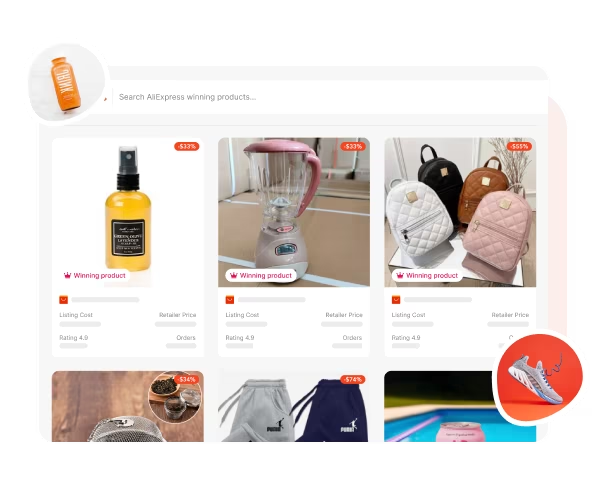
AliDrop covers the first, second and fourth rows. Its trending products view gives you a starting shortlist, the product analyzer helps you size up an item before it goes live, and the AliDrop Marketplace lets you search AliExpress, Alibaba and Temu in one place and import the product you pick to Shopify in one click (the first 7 days cost $1). For a broader comparison, see our roundup of dropshipping product research tools.
Common AliExpress product research mistakes
- Trusting "Best Match." It mixes in promoted listings. Sort by orders.
- Reading the all-time rating only. Recent reviews show current quality. Old ones show what the product used to be.
- Picking the cheapest store. A $0.80 saving disappears with one refund. Pay a little more for a store with history and fast replies.
- Ignoring delivery to your country. A product with great reviews from buyers in another region can still take weeks to reach your customers.
- Skipping the sample. Photos are often renders. The sample is the only way to know what your customer will open.
- Researching forever. Research narrows the field; only a small ad test tells you if a product sells from your store. Our guide on testing a dropshipping product before spending on ads covers the next step.
Turning research into sales
Good AliExpress product research gives you two or three products with real orders, solid recent reviews, a reliable store, outside demand and room for a 3x price. From there it's about speed: import the product, write a clear listing, and run a small, fixed-budget test.
AliDrop handles the busywork between research and your first order: trending products to start from, one-click import to Shopify with images and variants, AI-written first drafts of titles and descriptions, and automatic order sending to suppliers. Vetted US and EU suppliers with 2 to 5 day shipping are there for products where speed matters. Try AliDrop for $1 for the first 7 days and run your next shortlist through it.
AliExpress Product Research FAQs
How do I do product research on AliExpress?
Search a problem keyword, sort results by Orders, and filter for four stars and up. Shortlist listings with 1,000+ sold, a 4.6+ rating and recent photo reviews. Compare three stores per product, check outside demand on Google Trends, Amazon and the Meta Ad Library, do the landed cost math, then order samples of your top two or three.
How do I find the best-selling products on AliExpress?
Sort any search by Orders instead of Best Match, browse category best-seller lists, and use the free AliExpress Dropshipping Center to see order totals. Remember that the biggest sellers are also the most copied. A product with 2,000 to 20,000 orders often has proven demand without every store already running ads for it.
How many orders should an AliExpress product have before I sell it?
A useful rule of thumb is at least 1,000 orders on the listing with a rating of 4.6 or higher and recent photo reviews. Under 100 orders means demand is unproven. Past about 50,000 orders on one listing, assume many stores already sell it and you'll need a clear angle or better offer to stand out.
How can I tell if an AliExpress seller is reliable?
Open the store page and check positive feedback (aim for 95% or more), how long the store has been open, and recent reviews across its products. Send one practical question and judge the reply speed. Avoid stores selling branded goods at no-name prices, and keep a backup store for any product you scale.
Is AliExpress order data enough to pick a dropshipping product?
No. Order counts come from AliExpress shoppers worldwide paying AliExpress prices. Confirm demand in your own market with Google Trends, Amazon best-seller lists and active ads in the Meta Ad Library, then check that the product can sell for about three times its landed cost. A small ad test is the final proof.
What tools help with AliExpress product research?
The free AliExpress Dropshipping Center and image search cover the basics. Browser extensions add price history and store comparisons. AliDrop gives you trending products, a product analyzer and one-click import to Shopify, so a researched product goes live in minutes. No tool replaces ordering a sample and doing your own cost math.
Should I order a sample before selling an AliExpress product?
Yes, for every product you plan to advertise. A sample shows real quality, packaging and delivery time to your country, and gives you your own photos and video for ads. It costs the price of one unit and often saves you from a wave of refunds and bad reviews.