

Ecommerce is buying and selling goods or services over the internet, with the order and payment happening online. That covers a $12 phone case bought on Amazon, a wholesale order of 500 candles placed by a boutique, a used jacket sold on a resale app, and a Shopify store that never touches the products it sells.
So what is ecommerce in practice? It's a set of business types (who sells to whom), business models (how the product reaches the buyer), and channels (where the sale happens). This guide explains all three in plain English, gives you the latest verified ecommerce statistics for 2026, and then does something most definitions skip: it runs the actual numbers on the three ways a small seller usually starts, so you can see what each one costs before you spend anything.
What is ecommerce? The meaning in one paragraph
The ecommerce meaning is simple: electronic commerce, or any commercial transaction where the buyer places the order through a website, app, marketplace or messaging channel. The product can be physical (shoes, furniture), digital (an ebook, a course, software) or a service (a booked cleaning, a design job). Delivery can be by courier, by download or in person. What makes it ecommerce is that the transaction itself happens online.
People also use "online store", "online retail" and "digital commerce" for the same idea. Strictly, ecommerce is the transaction, and an ecommerce website or online store is just one place where it happens. A lot of ecommerce now runs through marketplaces such as Amazon, eBay and Etsy, or through social platforms, rather than through a brand's own site.
A very short history
The New York Times reported what's widely cited as the first secure online retail purchase on 11 August 1994, when a buyer used encryption software to pay for a Sting CD through a site called NetMarket (NYT archive). Amazon and eBay both launched the following year. Thirty-odd years later, online sales are a normal part of retail rather than a novelty, and the hard part has moved from "can I sell online?" to "can I sell online at a profit?"
How ecommerce works, step by step
Every online order follows roughly the same path, whether it's a $3 sticker or a $3,000 sofa. Here's how ecommerce works from the moment someone lands on a product page:
- Discovery. The shopper finds the product through search, an ad, a social post, a marketplace listing or an email.
- Product page and cart. They pick a size or colour and add it to the cart. The store shows price, shipping cost and delivery estimate.
- Checkout. The buyer enters an address and pays. A payment processor (Shopify Payments, Stripe, PayPal and so on) authorises the card and takes a fee. On Shopify's Basic plan in the US, online card rates start at 2.9% + 30 cents per transaction (Shopify pricing).
- Order notification. The seller, or the seller's app, receives the order. Stock is reduced and a confirmation email goes to the buyer.
- Fulfilment. Someone picks, packs and ships the item. That's either you, a warehouse (3PL), a print-on-demand printer, or a dropshipping supplier.
- Delivery and tracking. The carrier delivers and the tracking number updates the buyer.
- After the sale. Returns, refunds, reviews and repeat purchases. This is where most stores win or lose their margin.
Where ecommerce happens
There are four main sales channels, and most growing stores end up using more than one:
- Your own online store built on Shopify, WooCommerce or similar. You control branding, pricing and customer data, but you have to bring the traffic. If you're choosing a platform, our comparison of the best ecommerce website builders covers the trade-offs.
- Marketplaces like Amazon, eBay, Etsy and Walmart. Built-in buyers, but you pay referral or final value fees and compete on the same page as your rivals.
- Social commerce through TikTok Shop, Instagram and Facebook. Strong for impulse products and creators with an audience.
- Apps and messaging, from a brand's own mobile app to orders taken over WhatsApp.
How customers pay
Cards still dominate, followed by digital wallets (Apple Pay, Google Pay, PayPal, Shop Pay), buy now pay later services like Klarna and Afterpay, and bank transfers for larger B2B orders. Each method has its own fee, and those fees come out of your margin, so they belong in your pricing spreadsheet from day one.
Types of ecommerce: B2C, B2B, C2C, D2C and more
Types of ecommerce are usually grouped by who is selling to whom. Here are the six you'll see in most definitions, with a real example of each:
| Type | Who sells to whom | Example | Typical order |
|---|---|---|---|
| B2C (business to consumer) | A business sells to individual shoppers | Amazon, Walmart.com, most Shopify stores | One or two items, card payment |
| B2B (business to business) | A business sells to other businesses | Alibaba.com, Faire, office supply sites | Bulk quantities, invoices, net terms |
| C2C (consumer to consumer) | Individuals sell to each other via a platform | eBay, Facebook Marketplace, Poshmark | Used or handmade items |
| D2C / DTC (direct to consumer) | A brand sells its own products without retailers | Brands selling only on their own site | Branded products, repeat buyers |
| C2B (consumer to business) | Individuals sell services or content to companies | Freelancers, stock photographers, creators | Projects, licences, sponsorships |
| B2G (business to government) | Businesses sell to public bodies | Online procurement portals | Tenders, contracts |
B2C ecommerce
This is what most people picture: a store selling to the public. Orders are small, volumes are high, and marketing does most of the heavy lifting. Most new sellers start here because the path from first look to purchase is short. Someone sees the product, likes it, buys it.
B2B ecommerce
B2B is the giant most people forget about. Orders are bigger, buyers compare suppliers carefully, and prices often depend on quantity. Platforms like Faire connect independent brands with retailers who buy wholesale, and Alibaba.com connects buyers with manufacturers. If you sell to other businesses, our guide to B2B ecommerce marketing strategies goes further.

C2C ecommerce
Here the platform is the business and individuals are the sellers. eBay, Facebook Marketplace and resale apps take a fee or charge for promotion, and the sellers handle listing and shipping. It's the lowest-cost way to try selling online because you can start with things you already own.
D2C ecommerce
Direct-to-consumer brands make or source their own products and sell them straight to buyers, keeping the retailer's margin for themselves. The catch is that they also take on all the marketing cost, and the brand has to be strong enough that people seek it out.
Where dropshipping fits
Dropshipping often gets listed as a "type of ecommerce", but it's really a fulfilment model. A dropshipping store is usually B2C: it sells to consumers, and a supplier ships the order directly. That distinction matters because it tells you where your work actually is. In dropshipping, you're a marketing and customer-service business, not a logistics one.
Ecommerce business models: how the product reaches the buyer
Once you know who you're selling to, the next question is how you'll get the product to them. These are the ecommerce business models that matter for a small seller:
- Holding inventory. You buy stock upfront, store it, and ship each order yourself or through a 3PL. Best unit margins, biggest cash risk.
- Dropshipping. You list a supplier's products, and when an order comes in, the supplier ships it to your customer. No stock, lower margins, less control over delivery times. Our explainer on how dropshipping works walks through a full order.
- Print on demand (POD). You upload designs, and a printer produces and ships each item only after it sells. No stock, but base costs per item are high.
- Wholesale. You sell in bulk to other businesses. Fewer, bigger orders.
- Private label and white label. You put your brand on a manufacturer's product. Usually needs minimum order quantities.
- Digital products. Templates, courses, presets and software. Near-zero cost per sale, but you need an audience.
- Subscriptions. Recurring deliveries (coffee, razors, pet food) or recurring access (software, memberships).
Revenue models sit on top of these: straight product sales, subscriptions, transaction fees (marketplaces), advertising, and affiliate commissions. Most small stores live on product sales.
Ecommerce statistics 2026 (verified sources only)
If you searched "what is ecommerce" because you're sizing up the market, here's where it stands. Lots of ecommerce statistics posts quote forecasts that no one can trace back to a source. We've only included numbers we could check against the original publisher.
- US online sales hit $340.2 billion in Q2 2026. The US Census Bureau estimates retail ecommerce sales for the second quarter of 2026 at $340.2 billion (seasonally adjusted), up 12.2% on Q2 2025. Total retail grew 6.7% over the same period (US Census Bureau).
- Ecommerce is now 17.1% of all US retail. Same release, seasonally adjusted. Put another way, about $1 in every $6 spent in US retail now goes through an online order.
- Online is growing almost twice as fast as retail overall. 12.2% versus 6.7% year on year, per the same Census data.
- Business ecommerce is far bigger than retail. UNCTAD estimates that businesses in 43 economies made almost $27 trillion in ecommerce sales in 2022, and in most of those economies business-to-consumer sales were less than a quarter of the total. B2B is the bulk of it (UNCTAD).
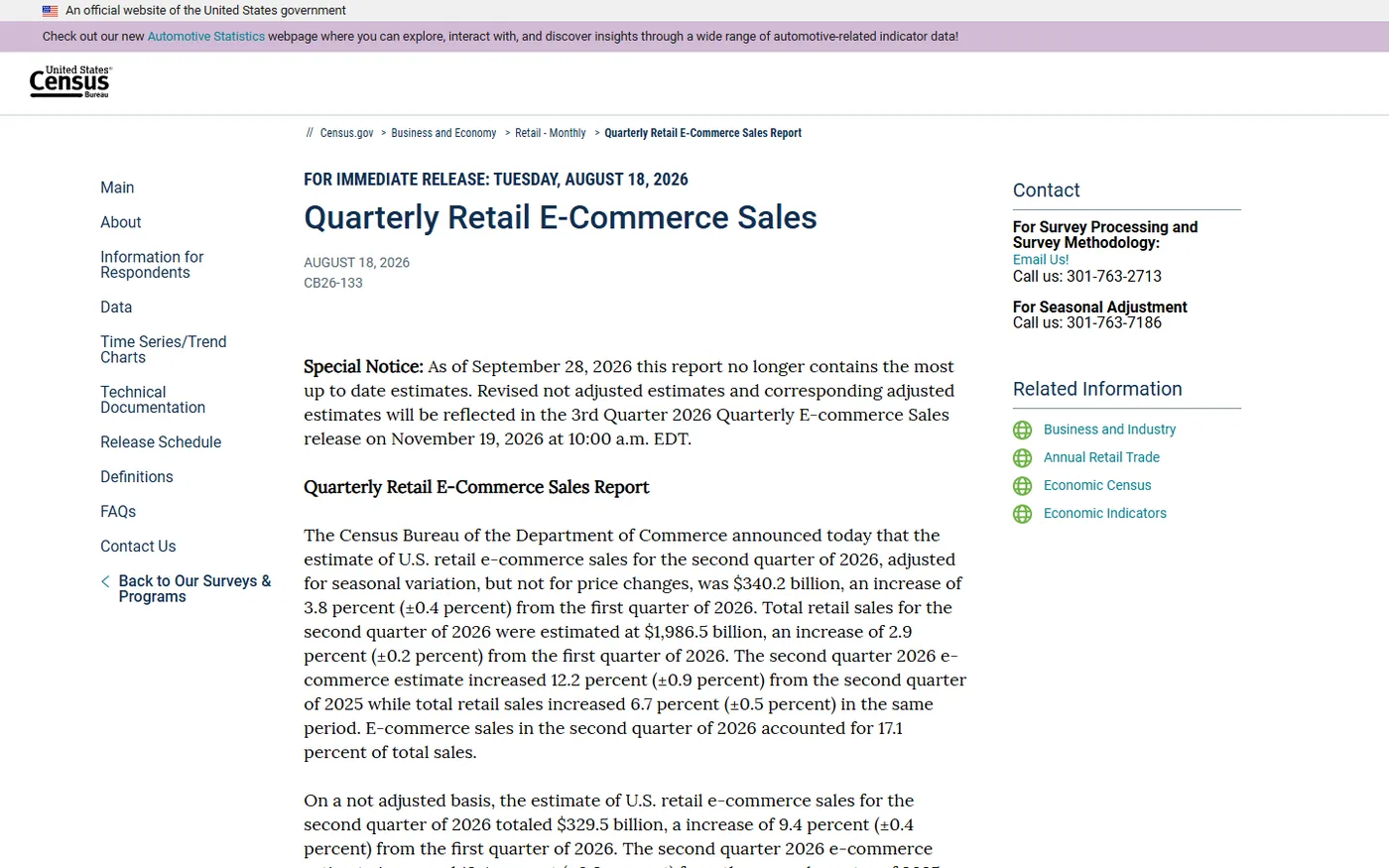
The Census Bureau publishes Q3 2026 figures on 19 November 2026, so check the page if you're reading this later. One more thing on statistics: global retail ecommerce forecasts from research firms vary by hundreds of billions of dollars depending on what they count, so treat any single "global ecommerce will hit $X" number as a rough estimate, not a fact.
How a small seller actually starts: dropshipping vs inventory vs print on demand
Knowing what is ecommerce on paper is the easy part. The real question for most readers is which model to start with when you have a few hundred dollars and a day job. Below is the month-one math for the three common routes.
These are worked examples with stated assumptions, not quotes. Plug in your own product's numbers. The store platform cost uses Shopify's US Basic plan at $39/month on monthly billing, and card fees use its published 2.9% + 30 cents online rate (Shopify pricing). Ad cost per sale is set at $12 for all three, which is a plausible early-stage number for a $30 product but varies hugely by niche.
Startup cost in month one
| Cost item | Dropshipping | Holding inventory | Print on demand |
|---|---|---|---|
| Store platform (Shopify Basic, monthly) | $39 | $39 | $39 |
| Product sourcing / fulfilment app | $1 for the first 7 days on AliDrop, then $39 for Starter | None needed | Usually free to connect |
| Stock bought upfront | $0 | 200 units x $5.50 landed = $1,100 | $0 |
| Samples | $30 (order 2 to check quality) | Included in bulk order | $25 (order your own design) |
| Packaging and shipping supplies | $0 | $60 | $0 |
| Test ad budget | $300 | $300 | $300 |
| Rough month-one total | about $410 | about $1,500 | about $365 |
Profit per $29.99 sale
| Per order | Dropshipping | Holding inventory | Print on demand (t-shirt) |
|---|---|---|---|
| Sale price | $29.99 | $29.99 | $29.99 |
| Product cost | $11.00 incl. supplier shipping | $5.50 landed | $13.00 base (assumed) |
| Shipping to customer | Included above | $5.00 | $4.75 |
| Card fee (2.9% + $0.30) | $1.17 | $1.17 | $1.17 |
| Ad cost per sale | $12.00 | $12.00 | $12.00 |
| Profit per order | $5.82 | $6.32 | -$0.93 |
Three things jump out.
Inventory and dropshipping earn similar money per order at small scale. The difference is risk. With inventory, you've spent $1,100 before you know whether anyone wants the product. If it flops, you own 200 of them. With dropshipping, a flop costs you the ad budget and you move on to the next test. That's why most first-time sellers start with dropshipping and switch to holding stock only for proven winners, where bulk pricing pushes the unit cost down.
Print on demand rarely survives paid ads on a $30 shirt. High base costs leave no room for a $12 acquisition cost. POD works when traffic is free or cheap: Etsy search, an existing social following, or niche communities. If you're weighing that route, our Etsy print on demand vs AliExpress dropshipping comparison breaks it down further.
Ad cost decides everything. Drop the ad cost per sale from $12 to $7 (through better creatives, email, or organic TikTok) and dropshipping profit nearly doubles to $10.82. Most stores that fail don't fail because of product cost. They fail because they never get acquisition cost under control. For a fuller breakdown of first-year costs, see how much it costs to start a dropshipping business.
Mistakes that sink first stores
- Pricing at 2x product cost and forgetting card fees, refunds and ads. Aim for at least 2.5x to 3x landed cost on paid traffic.
- Never ordering a sample. If the product is bad, you find out from refund requests instead of from your own mailbox.
- Promising "fast shipping" when the supplier ships from overseas in 10 to 15 days. Under the FTC's Mail, Internet, or Telephone Order Merchandise Rule, US sellers must ship within the time they state (or within 30 days if they don't state one) and offer customers a choice when there's a delay (FTC guide).
- Testing 30 products with $10 each instead of 3 products with $100 each. Tiny tests tell you nothing.
Ecommerce examples you already know
A few ecommerce examples across the different types and models:
- Amazon: B2C marketplace plus its own retail business. Third-party sellers use it to reach buyers they couldn't reach alone.
- eBay: started as C2C auctions and now mixes individual and business sellers.
- Etsy: a marketplace for handmade, vintage and print-on-demand goods.
- Alibaba.com and Faire: B2B platforms where businesses buy in bulk.
- AliExpress: a cross-border B2C marketplace that many dropshippers use as a supplier base.
- A one-product Shopify store: a D2C or dropshipping brand selling a single hero product through ads.
- Gumroad sellers: creators selling digital downloads such as templates and guides.
Benefits and real downsides of selling online
The upside is obvious: you can open a store for less than the cost of a market stall, sell around the clock, reach buyers in other states or countries, and see exactly which ad or email produced each sale.
The downsides get less airtime:
- Competition is one click away. Buyers compare your price with three other tabs before they check out.
- Traffic costs money. Opening a store is cheap. Getting people to visit it isn't.
- Returns and chargebacks. Buyers can't touch the product first, so return rates for online orders are higher than in store, especially in clothing.
- Shipping expectations keep rising. Buyers are used to fast delivery from big retailers, which is why many dropshippers now mix overseas suppliers with US or EU warehouses for their best sellers.
- Taxes and rules. Sales tax collection, business registration and consumer-protection rules apply to you as much as to a big retailer. Check your state's rules before your first sale, not after.
Where AliDrop fits
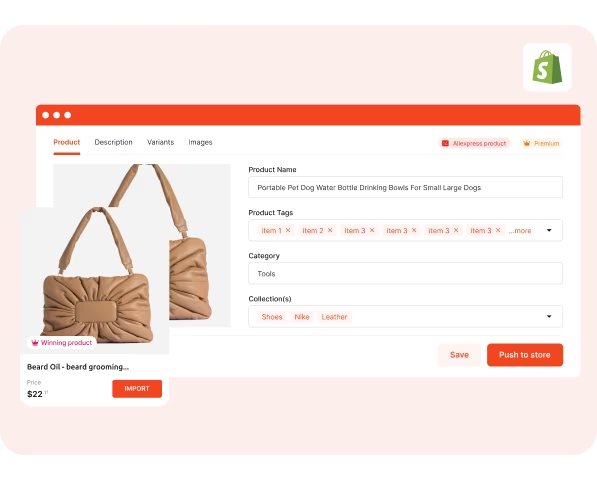
If the cost math above points you towards dropshipping, AliDrop handles the parts that eat time: finding products on AliExpress, Alibaba and Temu, importing them to Shopify in one click, and sending orders to the supplier automatically. You can also source from vetted US and EU suppliers when you need faster delivery for a product that's already selling (the US/EU suppliers page lists 2 to 5 day shipping). It costs $1 for the first 7 days, then plans start at $39/month (see pricing). Try AliDrop for $1 if you want to test a product idea this week.
It isn't the right tool for everyone. If you make your own products, sell digital downloads, or want to run a POD shirt brand, you don't need a dropshipping app.
Getting started this week
So, what is ecommerce for a small seller? It's any sale where the order and payment happen online, and it comes in more shapes than the B2C store most people picture. The choice that matters most isn't B2B versus B2C. It's how much cash you put at risk before your first sale. Dropshipping keeps that number low, inventory raises it in exchange for better margins later, and print on demand works best when your traffic is free.
Pick one product, run the cost table above with real numbers, order a sample, and spend a fixed test budget. If you want a step-by-step plan, our guide on how to start a dropshipping business picks up where this leaves off. When you're ready to list products, start with AliDrop for $1 for the first 7 days.
Ecommerce FAQs
What is ecommerce in simple words?
Ecommerce is buying or selling something over the internet, where the order and payment happen online. It covers physical products shipped to your door, digital downloads like ebooks or templates, and services you book and pay for online. Amazon orders, Etsy purchases, eBay auctions and small Shopify stores are all ecommerce, even though they work in very different ways behind the scenes.
What are the main types of ecommerce?
The main types are B2C (businesses selling to consumers), B2B (businesses selling to other businesses), C2C (individuals selling to each other through a platform like eBay), and D2C (brands selling their own products directly to buyers). Less common types include C2B, where individuals sell services or content to companies, and B2G, where businesses sell to government bodies.
Is dropshipping a type of ecommerce?
Dropshipping is better described as a fulfilment model than a separate type. Most dropshipping stores are B2C: they sell to consumers, and a supplier ships each order straight to the buyer. The store owner never holds stock, so the job is mainly marketing, product selection and customer service rather than packing and shipping.
How much does it cost to start an ecommerce business?
A dropshipping or print-on-demand store can start for roughly $365 to $410 in the first month, including a store plan, samples and a small test ad budget. Holding inventory usually needs $1,000 or more because you buy stock upfront. Your biggest ongoing cost is usually advertising, so budget for testing before expecting profit.
What is an example of ecommerce?
Ordering a phone case on Amazon is a B2C ecommerce example. A boutique buying 200 candles wholesale on Faire is B2B. Selling your old jacket on eBay or Facebook Marketplace is C2C. A small brand selling one product through its own Shopify store, with a supplier shipping each order, is a dropshipping example.
How big is ecommerce in 2026?
According to the US Census Bureau, US retail ecommerce sales were an estimated $340.2 billion in the second quarter of 2026, seasonally adjusted. That's 17.1% of all US retail sales and 12.2% higher than a year earlier. Globally, UNCTAD estimates business ecommerce sales across 43 economies at almost $27 trillion in 2022, most of it B2B.
Do I need a website to sell online?
No. You can start on marketplaces like eBay, Etsy or Amazon, or on social platforms like TikTok Shop and Facebook Marketplace, without your own site. Your own store gives you control over branding, pricing and customer data, though, so many sellers start on a marketplace and add a Shopify store once they know what sells.