

The best secret websites to make money in 2026 aren't really secret. They're legit platforms most people have never heard of: research sites like Prolific and Respondent that pay for your opinion, Neighbor and Peerspace that rent out space you're not using, and Preply and DataAnnotation that pay for skills you already have. None of them will replace a salary on their own, but several pay real cash within days.
We checked every site below on its own website or help center in October 2026: what it pays, the minimum payout, who it's for, and the catch nobody mentions. Two sites that still appear on other "websites that pay you" lists have shut down, so we've flagged those too. At the end, there's an honest look at reselling and dropshipping, which takes more effort but doesn't cap your income at an hourly rate.
How we picked these legit websites to make money
A site made this list only if it passed four checks:
- It's operating right now. We loaded each site and its help pages in October 2026. That's how we caught two closures.
- Pay terms are published. Either a rate, a fee split or a payout rule on the company's own site. No "earn up to $500 a day" claims.
- Payout is real money, or clearly stated credit (we flag the one that pays in Google Play credit).
- No pay-to-join schemes. One site charges a one-time registration fee in some cities, and we say so.
We left out anything with vague pay, mandatory "starter kits", or a history of not paying. We also left out the obvious big names everyone already knows. These are the little-known sites to earn money online that actually hold up.
Secret websites to make money: quick comparison
| Site | What you do | What it pays | The catch |
|---|---|---|---|
| Prolific | Academic and AI research studies | Studies must pay at least £6/$8 an hour | Waitlist; good studies fill in minutes |
| Respondent | Paid interviews and focus groups | $75 average payout per session | You only get picked if you fit the brief |
| UserTesting | Test websites and apps out loud | Amount shown on each test; paid via PayPal | 14-day wait for payment |
| Google Opinion Rewards | Short phone surveys | Google Play credit (Android) | Small amounts; credits expire after a year |
| DataAnnotation | Train and rate AI models | Hourly rate set per project, paid via PayPal | Must pass an assessment; work isn't guaranteed |
| Preply | Online tutoring | You set your rate; Preply's commission falls from 33% to 18% | Preply keeps 100% of each trial lesson |
| Neighbor | Rent out storage or parking | Your price minus 4.9% + $0.30 per payout | Renters' items stay on your property |
| Peerspace | Rent your space for shoots and events | Your price minus a 15% to 20% host fee | Needs a photogenic or unusual space |
| Turo | Rent out your car | 70%, 80% or 90% of the trip price | Higher share = higher damage responsibility |
| Rover | Pet sitting and dog walking | Sitters generally keep 85% | Real responsibility for someone's pet |
| TaskRabbit | Local jobs: assembly, moving, mounting | You keep 100% of your rate plus tips | $25 registration fee in some cities |
| Gumroad | Sell digital products | 10% + $0.50 per direct sale | 30% on sales from its Discover marketplace |
| Etsy | Sell printables and digital downloads | $0.20 listing + 6.5% transaction fee + processing | Crowded search; fees add up |
| Shutterstock | License your photos and videos | 15% to 40% of each licence | Earnings levels reset every January |
Websites that pay you for your opinion
Research platforms are the closest thing to an easy start. You don't need a skill, just honest answers and a working microphone for some of them. They pay better than classic survey sites because the buyers are universities, AI labs and product teams with real budgets.
1. Prolific
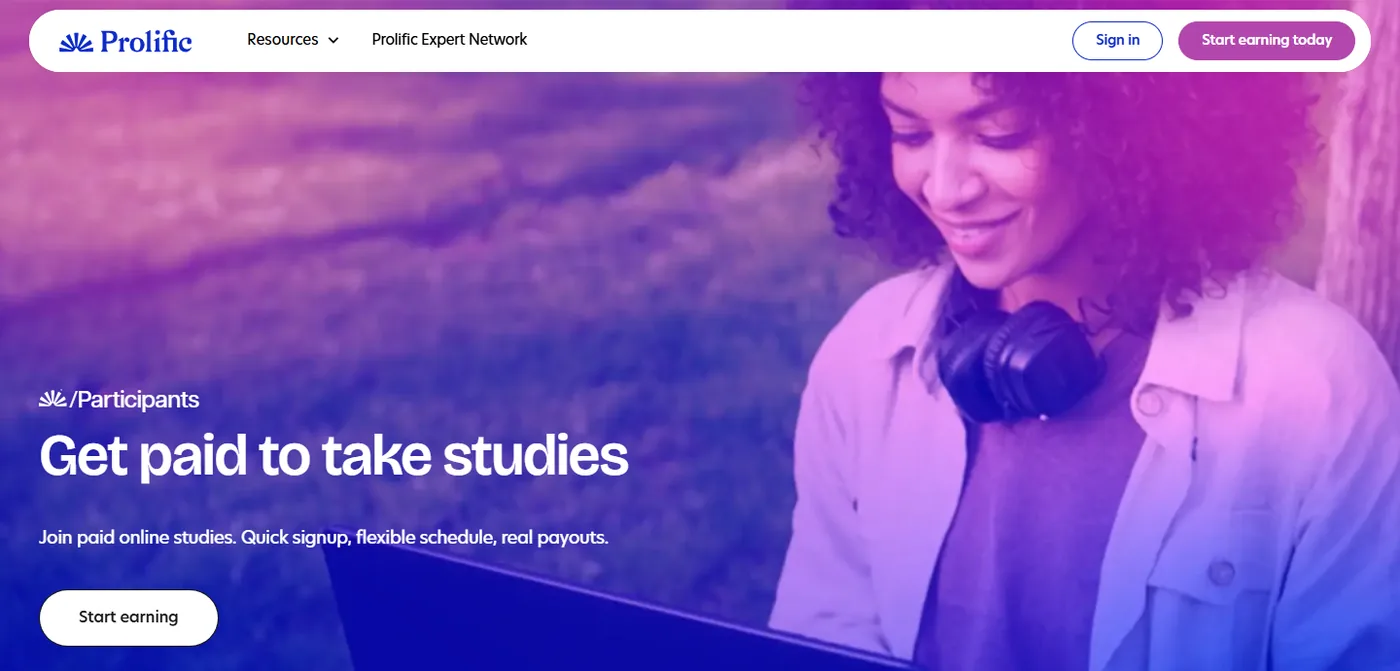
Who it's for: anyone who can spare 5 to 30 minutes at a time. What it pays: Prolific requires researchers to pay at least £6 or $8 an hour and recommends £9 or $12 (Prolific payment principles). It pays real money, not gift cards. Payout: you can cash out to PayPal once your approved balance reaches £6 or $6, generally once a day. The catch: new participants join a waitlist, and popular studies fill fast, so people who earn well tend to keep the dashboard open in a browser tab.
2. Respondent
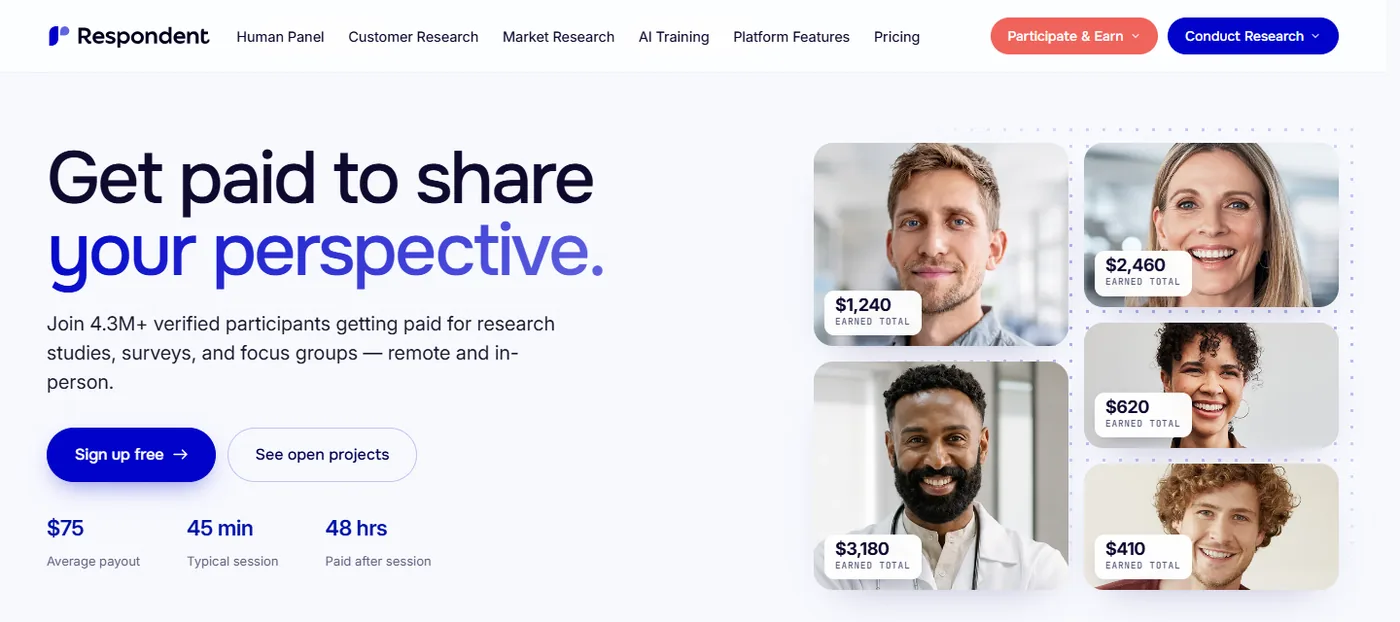
Who it's for: professionals and consumers who match a specific research brief (software buyers, nurses, parents, small business owners). What it pays: Respondent's participant page lists a $75 average payout for a typical 45-minute session, paid 48 hours after the session through Tremendous. The catch: you apply to each study and most applications won't be picked. A detailed, honest profile matters more than speed. Never fudge your job title to qualify; researchers verify, and it gets accounts banned.
3. UserTesting
Who it's for: people comfortable talking through what they see on a website or app while recording their screen. What it pays: UserTesting's help center says your test feed always shows how much each test pays, and payments go out via PayPal 14 days after you complete a test (UserTesting help). The catch: every test starts with screener questions, and you won't qualify for most. Mumbling or going silent gets tests rejected.
4. Google Opinion Rewards
Who it's for: Android users who buy apps, books or subscriptions on Google Play anyway. What it pays: Google Play credit, with the amount depending on how many questions a survey has and how long it takes. The catch: the amounts are small, surveys arrive irregularly, and Google's help center says each credit expires one year after you earn it. It's a nice extra, not income.
Little-known sites to earn money online with skills you already have
5. DataAnnotation
Who it's for: strong writers, fact-checkers, coders and subject experts. You rate AI answers, write prompts and check reasoning. What it pays: each project shows its own hourly rate, payments go through PayPal, and the company says on its FAQ that it charges no signup fees and has paid contractors hundreds of millions of dollars since 2020 (DataAnnotation FAQ). The catch: you take an unpaid assessment first, and plenty of applicants never hear back. Work volume isn't guaranteed even after you pass, so don't quit anything for it.
6. Preply
Who it's for: fluent speakers of a language, or anyone who can teach a subject like maths or coding over video. What it pays: you set your own hourly rate, and Preply says English tutors charge $15 to $25 an hour on average. Preply keeps 100% of the trial lesson with each new student, then takes a commission that starts at 33% and drops to 18% as you teach more hours. The catch: that free trial lesson means your first hours with every student pay nothing, so price your later lessons with that in mind.

Legit websites to make money from things you already own
7. Neighbor
Who it's for: anyone with an empty garage, shed, spare room, driveway or barn. What it pays: you set a monthly price. Listing is free, and Neighbor's help center says it takes a processing fee of 4.9% + $0.30 from each monthly payout (Neighbor help). Hosts are covered by a $1M Host Guarantee. The catch: a stranger's stuff lives on your property for months, and demand depends heavily on where you live. Suburban garages near cities rent best.
8. Peerspace
Who it's for: owners of lofts, studios, unusual homes, gardens or small venues. Photographers, film crews and teams book them by the hour. What it pays: Peerspace says it has paid hosts over $500 million. Listing is free, and its help center puts the host service fee at 15% to 20% depending on location, earnings and hosting history. The catch: an ordinary living room won't get booked. You need a space with a look, and you'll be cleaning after shoots.
9. Turo
Who it's for: car owners who don't need their car every day. What it pays: US hosts pick one of three earnings plans. "More peace of mind" keeps 70% of the trip price with $250 damage responsibility, "Balanced" keeps 80% with $1,500, and "More earnings" keeps 90% with $2,750 (Turo help). The catch: mileage, cleaning, faster wear and the occasional damage claim all come out of your pocket. Run the numbers against your loan and insurance before listing.
Websites that pay you for local help
10. Rover
Who it's for: dog lovers with flexible days. Services include walking, drop-in visits, day care and overnight boarding. What it pays: you set your own prices, and Rover's help center says sitters generally take home 85% of each booking, with rates varying by country and service type. Bookings include the Rover Guarantee, with up to $25,000 in vet care reimbursement. The catch: one escaped dog can end your Rover career. Only take pets you can handle.
11. TaskRabbit
Who it's for: handy people who can assemble furniture, mount TVs, help with moves or run errands. What it pays: TaskRabbit says Taskers keep 100% of what they charge plus tips, and the client pays the platform's fees on top. The catch: in some cities there's a one-time $25 registration fee, and you'll need your own tools and transport.
Sites that pay you to sell what you make
12. Gumroad
Who it's for: creators selling templates, guides, presets, courses or music. What it pays: Gumroad charges 10% + $0.50 per sale through your own link or profile and 30% on sales that come through its Discover marketplace. It has also handled sales tax worldwide as merchant of record since January 2025. The catch: Gumroad doesn't bring you buyers. You need an audience, even a small one.
13. Etsy (digital downloads)
Who it's for: people who can design planners, wall art, wedding templates or kids' worksheets. What it pays: in the US, Etsy charges $0.20 per listing, a 6.5% transaction fee and payment processing of 3% + $0.25 per order. Digital files deliver automatically, so each extra sale costs you nothing to fulfil. The catch: popular categories are packed, so niche, specific products win over generic ones.
14. Shutterstock Contributor
Who it's for: photographers and videographers with a back catalogue. What it pays: 15% to 40% of what Shutterstock receives per licence, across six earnings levels based on downloads, and levels reset to the first level every 1 January (Shutterstock help). The catch: per-download earnings are often small. It works as a long-tail side income for people who already shoot a lot.
Sites that no longer pay: check before you sign up
Old "secret websites to make money" lists age badly. Two sites that still show up in roundups have closed:
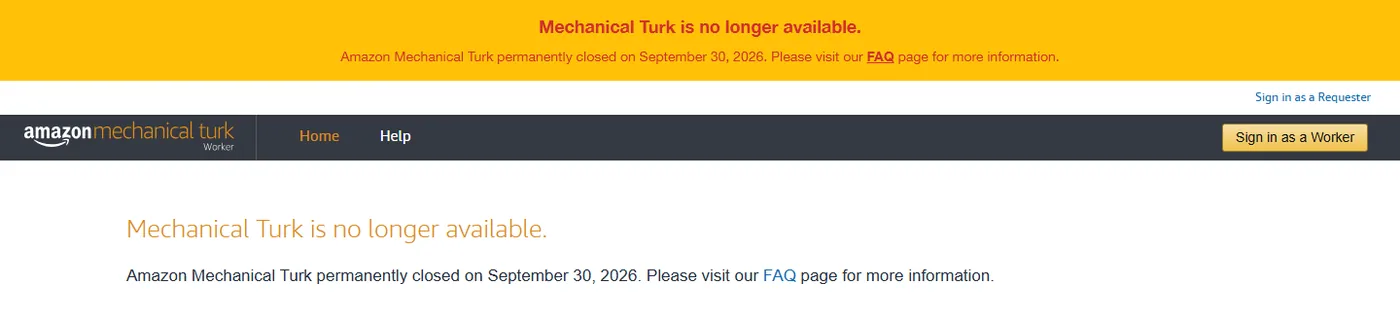
- Amazon Mechanical Turk permanently closed on 30 September 2026, according to the notice on mturk.com. For years it was the default microtask site on every list.
- Decluttr, the trade-in site for phones, games and CDs, now shows a notice saying the website has closed and only handles existing orders.
If a list still recommends either one, the rest of its advice probably hasn't been checked recently either.
How to tell a legit money-making website from a scam
Not every site sold as one of the secret websites to make money is real. Fake "get paid online" sites are common, and the FTC's guidance on job scams lists the classic signs. Run any new site through these checks before you hand over details:
- Search "[site name] closed" and "[site name] payment proof". Recent forum posts tell you more than the homepage.
- Find the pay terms on the site itself. Legit platforms publish a rate, fee or payout rule. "Earn up to" claims with no detail are a warning.
- Never pay to get paid. Starter kits, "training fees" and upfront deposits are the oldest trick going. A one-off background-check or registration fee from a known platform is different, but it should be stated openly.
- Check how you get paid. PayPal, bank transfer or a named provider like Tremendous is normal. Crypto-only payouts, gift cards from unknown brands or "send us the overpayment back" requests are not.
- Don't hand over a Social Security number until a real payout needs it. US platforms legitimately ask for tax details once you earn, not on the sign-up page.
What a realistic month looks like
Here's a sample month for someone with a day job using three of these sites. The numbers are illustrative, not promises:
- Prolific: 6 hours of studies at the $8 minimum = $48
- Respondent: one 45-minute interview at roughly the $75 average = $75
- Neighbor: a single-car garage rented at $120/month, minus 4.9% + $0.30 = about $114
That's roughly $237 a month. Helpful for a bill or two, and the Neighbor part is close to passive. But look at what limits it: research pays per hour of your time, and rental income is capped by the space you have. To go beyond a few hundred dollars, you need something that grows without you adding hours.
The bigger-upside option: reselling and dropshipping
Every site above pays you for time or for an asset. Selling products is different, because one good listing or ad can sell 10 units or 1,000 without you working 100 times harder. It also comes with real risk, so here's the honest version.
Reselling means buying underpriced items (thrift stores, clearance aisles, estate sales) and listing them on eBay, Facebook Marketplace or Poshmark. It's the lowest-risk way to learn product pricing because you start with $20 of stock. The limit is your time: every item needs sourcing, photos, a listing and a trip to the post office. Cross-listing tools help, and our roundup of cross-listing apps for reselling covers the main ones.
Dropshipping means running an online store where a supplier ships each order straight to your customer. You never buy stock, so your risk is the store plan and whatever you spend on ads. The upside is scale. The downside is that most first products don't sell, margins get eaten by ad costs, and you handle the customer-service side of someone else's shipping. Our guide on how to make money with dropshipping has the full cost breakdown, and if you're still unclear on the basics, start with what ecommerce is and how it works.
A quick example: a $29.99 product that costs you $11 delivered from the supplier, with $1.17 in card fees, leaves $17.82 before ads. If ads cost $12 per sale, you keep $5.82. Sell 10 a day and that's around $1,700 a month. Sell zero and you've lost your test budget. Both outcomes are common.

If you want to try it, AliDrop finds products from AliExpress, Alibaba and Temu, imports them to Shopify in one click, and sends orders to suppliers automatically. You can read how it works on the AliExpress dropshipping page, browse more ideas on our make money online hub, or start for $1 for the first 7 days. Plans start at $39/month after that (pricing).
Don't forget taxes
Money from all of these sites is taxable income in the US, whether or not you receive a form. The IRS says payment apps and online marketplaces must send a Form 1099-K when you receive over $20,000 across more than 200 transactions in a year, but they can send one for lower amounts too, and you still have to report income below that threshold (IRS Form 1099-K guide). The IRS gig economy tax center explains self-employment tax and deductions. Keep a simple spreadsheet of every payout from day one.
Which site should you start with?
The best secret websites to make money depend on what you have to offer. If you want cash this week with no skills or setup, join Prolific and Respondent. If you have a skill, apply to DataAnnotation or Preply. If you have unused space or a car, Neighbor, Peerspace or Turo pay you for something that's sitting idle. And if you'd rather build something that isn't capped by your hours, test a small reselling or dropshipping store alongside them.
Whatever you pick, check the site's own help pages before you sign up. Pay terms change, and as Mechanical Turk showed, even well-known platforms close. Ready to test a product instead? Try AliDrop for $1 and see whether selling online suits you.
Money-Making Websites FAQs
Are secret websites to make money legit?
Some are and many aren't. The ones in this guide are real, operating companies that publish their pay terms on their own websites, such as Prolific's minimum hourly rate or Turo's host share. Avoid any site that charges you to join, hides how you get paid, or promises large daily earnings without explaining where the money comes from.
Which websites pay you the fastest?
Respondent says it pays 48 hours after a verified session, and Prolific lets you cash out to PayPal once your approved balance reaches £6 or $6, generally once a day. UserTesting pays via PayPal 14 days after you complete a test. Rental sites like Neighbor pay monthly, so they're slower to start but steadier once booked.
Can you really make money online without paying anything?
Yes. Research sites like Prolific, Respondent and UserTesting are free to join, and so are Neighbor, Peerspace and Preply listings. TaskRabbit charges a one-time $25 registration fee in some cities, which it states openly. If an unknown site asks for a starter kit, training fee or deposit before you earn, treat it as a scam.
How much can you make from these websites in a month?
For most people, a few hundred dollars a month is realistic when combining two or three sites part time. Research studies pay per hour of your time, and rental income is limited by the space or car you have. Bigger amounts usually come from skills work like tutoring or AI training, or from selling products, which also carries more risk.
Do I have to pay taxes on money from these sites?
Yes, in the US this money is taxable income even if you never receive a tax form. The IRS says platforms must issue a Form 1099-K once you receive over $20,000 across more than 200 transactions, but they may send one for less, and you still have to report smaller amounts. Track every payout in a spreadsheet as you go.
Is Amazon Mechanical Turk still available?
No. The notice on mturk.com says Amazon Mechanical Turk permanently closed on 30 September 2026. If you relied on it for microtasks, research platforms such as Prolific and AI training sites such as DataAnnotation are the closest alternatives, although both have their own screening and waitlists.
Is dropshipping a better way to make money than these sites?
It has a higher ceiling but more risk. Research and gig sites pay for your time with almost no downside. A dropshipping store can grow without you adding hours, but most first products don't sell and ad costs can wipe out margins. Many people do both: steady side income from these sites while they test products.