 English
 Portuguese
 French
 German
 Italian
 Spanish
A step-by-step Shopify dropshipping tutorial: choose a plan, set up your store, connect AliExpress, import and price products, and launch with a checklist.
Winning products, one-click import to Shopify and orders placed with suppliers.
Try AliDrop for $17-day free trial · 4.8 ★ on Shopify · Cancel anytimeTo dropship on Shopify with AliExpress, you open a Shopify store, install a dropshipping app that connects AliExpress to Shopify, import products, set your prices, and let the app send each paid order to the AliExpress supplier, who ships it straight to your customer. The whole setup takes a weekend if you know which settings matter.
This tutorial covers Shopify dropshipping step by step, in the order you'd actually do it, with real 2026 Shopify prices, the admin menu paths, a pricing formula with worked math, and a launch checklist. It's written for a first store, so nothing assumes you've used Shopify before.
How to dropship on Shopify with AliExpress: what you need first
| Item | Why you need it | Typical cost |
|---|---|---|
| Shopify account | Your storefront, checkout and order admin | 3-day free trial, then $1/month for 3 months, then from $39/month |
| AliExpress account | To pay suppliers for each order | Free |
| Dropshipping app | Imports products and forwards orders to AliExpress | Some apps have free plans; AliDrop costs $1 for the first 7 days, then from $39/month |
| Payment card | Suppliers are paid per order, often before your store payout arrives | Keep a buffer of a few hundred dollars |
| Domain name | yourstore.com looks more trustworthy than a myshopify.com address | Roughly $10 to $20 a year |
| Test budget | Samples and your first ads | $150 to $500 to start |
If you're still getting your head around the business model itself, read how dropshipping works first. It covers the order flow, margins and tax basics this tutorial builds on.
Step 1: Choose a Shopify plan (2026 prices)
Go to shopify.com/pricing and start the free trial. In October 2026, Shopify's US pricing page offers 3 days free, then $1 a month for the first 3 months on a monthly plan. After that, you pay the regular rate:
| Plan | Billed monthly | Billed yearly (per month) | Staff accounts | Good for |
|---|---|---|---|---|
| Basic | $39 | $29 | Owner only | Your first dropshipping store |
| Grow | $105 | $89 | 5 | When you hire a VA or support help |
| Advanced | $399 | $359 | 15 | High-volume stores selling internationally |
| Plus | From $2,300 | n/a | Unlimited | Large brands |
Pick Basic. It has everything a dropshipping store needs: unlimited products, discount codes, abandoned cart emails and the standard checkout. Upgrade only when you need staff accounts or lower card rates at higher volume. Two things to know before you commit:
- Prices vary by country. Shopify localizes its plans, so the figure you see at sign-up may differ from the US prices above.
- Card fees are separate. With Shopify Payments in the US, online card rates start at 2.9% + 30 cents on Basic, 2.7% on Grow and 2.5% on Advanced. Using a third-party gateway instead adds an extra transaction fee. Your exact rate is listed in your admin under Settings → Payments.
Step 2: Set up your store basics
Before touching the design, get the settings right. These are the ones dropshippers get wrong most often:
- Store name and contact email. Settings → General. Use a support address on your own domain once you have one (support@yourstore.com).
- Store currency. Settings → General → Store defaults. Set it to the currency of your main market. If you sell to the US, use USD even if you live elsewhere.
- Domain. Settings → Domains → Buy new domain, or connect one you bought elsewhere. Keep it short and avoid hyphens.
- Shipping rates. Settings → Shipping and delivery. Most AliExpress dropshippers set a free shipping rate for their main country and build the shipping cost into the product price. Add a paid express option only if your supplier offers a genuinely faster method.
- Markets. Settings → Markets. Start with one or two countries you can deliver to reliably. Selling everywhere on day one means delivery times you can't control.
- Taxes. Settings → Taxes and duties. Shopify can calculate sales tax at checkout, but registering in a state or country is your job.
Step 3: Pick and customize a theme
Go to Online Store → Themes. New stores get one of Shopify's free themes by default, and in 2026 that's usually Horizon, Shopify's newer free theme framework. For a first dropshipping store, a free theme is plenty. Paid themes from the Theme Store cost a one-time fee and add polish, not sales.
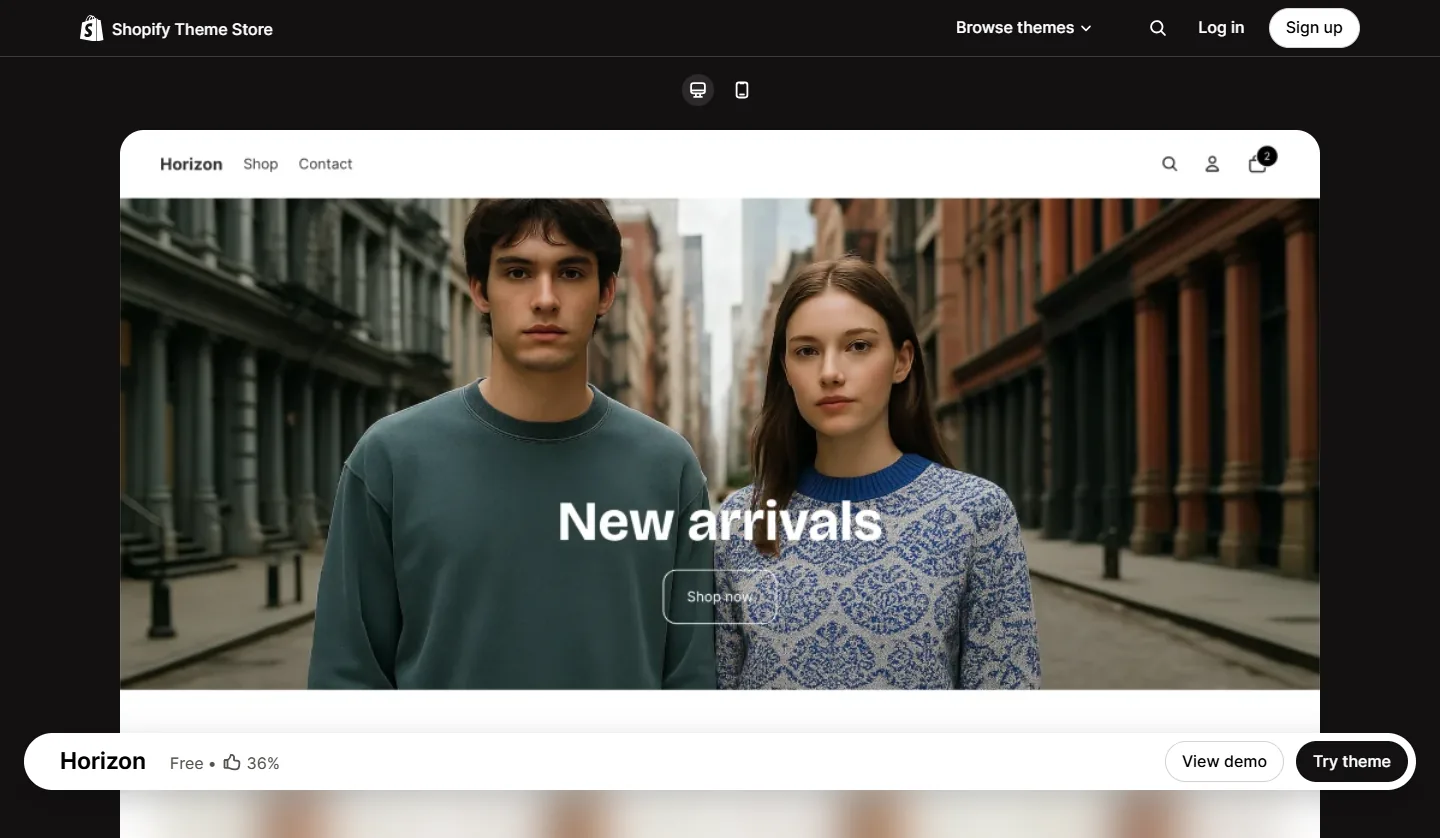
Click Customize and set up only what a buyer needs:
- A homepage hero with one clear product or collection, not a rotating slideshow.
- A header menu with 3 to 5 links (Shop, a key collection, Track order, Contact).
- A footer with your policies, contact details and a short "about us" line.
- A product page template showing price, variants, delivery estimate, return terms and reviews above the fold on mobile.
Check everything on your phone. Most dropshipping traffic comes from social ads on mobile, so a desktop-only check misses where buyers actually land. Our roundup of the best Shopify themes for dropshipping compares free and paid options if you want to go further.
Step 4: Connect AliExpress to Shopify with a dropshipping app
Shopify doesn't connect to AliExpress on its own. You need an app from the Shopify App Store that does three jobs: imports AliExpress listings into your store, keeps the link between your product and the supplier's product, and forwards paid orders to that supplier.
Popular options include AliDrop, DSers and AutoDS. They differ in pricing, supplier range and how much of the ordering they automate, so compare the current plans on each app's listing before installing. To connect with AliDrop, for example:
- Sign up for an AliDrop account and start the 7-day trial, which costs $1.
- Connect your Shopify store when prompted and approve the app permissions in your Shopify admin.
- Link your AliExpress account so orders can be placed with suppliers.
- Set your default pricing rules and shipping preferences before importing anything.
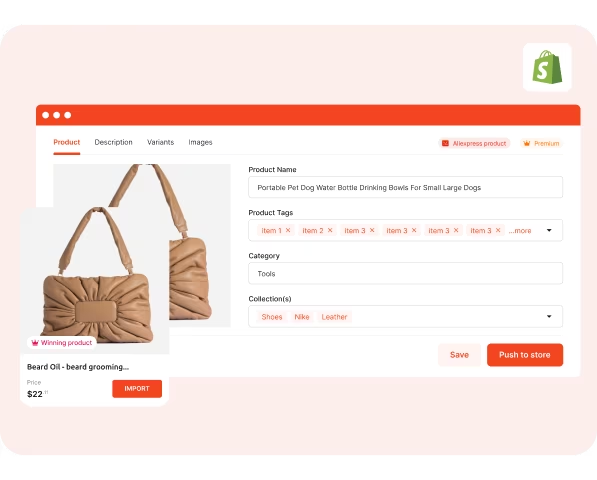
Step 5: Find and import AliExpress products
Product choice decides most of your results, so don't import the first 50 things you see. A product worth testing usually ticks these boxes:
- Landed cost (product plus shipping) under about $15, so a 2.5 to 3 times markup still lands under $50.
- Solves a visible problem or looks good in a 10-second video.
- Light, unbreakable and not size-sensitive, which cuts damage and returns.
- Hundreds of orders on the supplier's listing with recent photo reviews.
- No brand names, logos or trademarked characters.
Once you have 10 to 15 candidates, import them through your app. Then edit every listing before it goes live:
- Rewrite the title in plain English (customers don't search "2026 New Hot Sale Portable Multifunction").
- Write a short description with 3 to 5 benefits, sizes, materials and what's in the box.
- Delete blurry images, watermarked images and any photo with Chinese text you can't explain.
- Remove variants your supplier rarely has in stock.
- Add the honest delivery range from the supplier's shipping method.
- Put the product in a collection so it shows up in your menu.
Step 6: Price your products (formula with real math)
Pricing is the step that decides whether you can dropship on Shopify with AliExpress at a profit. Most failed Shopify AliExpress dropshipping stores priced from product cost alone. Use the full landed cost and check that there's room left for ads.
Formula: retail price = (product cost + shipping + duty allowance) × markup, rounded to a .99 or .95 ending. Then: break-even ad cost = retail price − landed cost − card fees.
Worked example with a phone stand sold to US customers:
| Step | Calculation | Result |
|---|---|---|
| Landed cost | $4.80 product + $2.60 shipping + $0.80 duty allowance | $8.20 |
| Retail price | $8.20 × 3 = $24.60, rounded | $24.99 |
| Card fees (Shopify Basic US rate, 2.9% + $0.30) | $0.72 + $0.30 | $1.02 |
| Gross profit before ads | $24.99 − $8.20 − $1.02 | $15.77 |
| Target profit (25% of price) | $24.99 × 0.25 | $6.25 |
| Maximum ad cost per sale | $15.77 − $6.25 | $9.52 |
If your ads can get a sale for under $9.52, the product makes your target margin. If they can't get under $15.77, every sale loses money and you either raise the price, bundle, or drop the product. The duty allowance matters because US Customs ended duty-free de minimis treatment for all countries on August 29, 2025, so low-value parcels from China are no longer automatically duty-free. Our guide to AliExpress import tax and customs duties breaks this down by country.
Markups that tend to work by landed cost (a starting point, not a rule):
| Landed cost | Markup | Example retail price |
|---|---|---|
| Under $5 | 3 to 4 times | $4 landed → $14.99 |
| $5 to $15 | 2.5 to 3 times | $10 landed → $27.99 |
| $15 to $40 | 2 to 2.5 times | $25 landed → $59.99 |
| Over $40 | 1.6 to 2 times | $60 landed → $109.99 |
Skip fake "compare at" prices. Showing $49.99 crossed out on a product that never sold for $49.99 can break consumer protection rules and makes careful shoppers suspicious.
Step 7: Set up payments
Go to Settings → Payments.
- Activate Shopify Payments if it's available in your country. It's the simplest option and avoids the extra third-party transaction fee. You'll need business or personal ID details and a bank account for payouts.
- Add PayPal. Plenty of shoppers prefer it, and it appears as an express checkout button.
- Turn on express wallets such as Shop Pay, Apple Pay and Google Pay. They cut checkout time on mobile.
- Place a test order to make sure checkout works end to end, then refund it.
If Shopify Payments isn't available where you live, connect a supported third-party provider. Expect new-account payout holds with any provider, which is why you need cash on hand to pay suppliers in the first weeks.
Step 8: Write your store policies
Go to Settings → Policies. Shopify can generate an automated return policy, shipping policy, terms of service and contact information from your store settings, and offers templates for others. The Shopify Help Center walks through each one. Templates are a starting point; edit them to match how AliExpress orders actually work:
- Shipping policy: processing time plus delivery time per country, stated as a range ("usually 8 to 15 business days to the US").
- Return policy: how many days, who pays return shipping, and what happens with damaged items. Returns to China rarely make financial sense, so many stores refund or reship damaged items on photo proof.
- Privacy policy and terms of service: use the templates, then add your business name and contact details.
For wording that works with overseas suppliers, see how to create dropshipping return and refund policies.
Step 9: Fulfil your first orders
When a customer pays, the order appears in Shopify under Orders. From there:
- Check the address and contact details look right.
- Send the order to the supplier, either automatically through your app or by clicking "order" in the app's order list.
- Pay the supplier for the product and shipping.
- Wait for the tracking number to sync back to Shopify. The customer gets a shipping confirmation email when it does.
- Watch for orders that sit unshipped for more than 5 days and message the supplier.

Shopify dropshipping launch checklist
Before you switch on ads, run through this list. It's the last part of learning how to dropship on Shopify with AliExpress, and the part people skip.
- Plan chosen and billing confirmed.
- Custom domain connected and set as primary.
- Store currency matches your main market.
- Free or flat shipping rate set for each country you sell to.
- Theme customized and checked on mobile.
- 10 to 15 products imported, rewritten and priced from landed cost.
- Samples of your top products ordered and checked.
- Shopify Payments or another provider active, plus PayPal.
- Shipping, return, privacy and terms policies saved and linked in the footer.
- Contact page and support email working.
- Test order placed and refunded.
- Dropshipping app connected to AliExpress with a payment card on file.
- Analytics and your ad platform's tracking installed.
- Store password removed under Online Store → Preferences.
Mistakes that sink first Shopify AliExpress stores
- Listing slow-shipping products with "fast shipping" claims. If the supplier uses economy mail, say so. Honest ranges get fewer chargebacks than optimistic ones.
- Importing 100 products without editing them. Raw AliExpress titles and images scream "dropshipping store" and kill trust.
- Picking suppliers by price alone. A supplier $0.40 cheaper with a 2-star communication record will cost you more in refunds.
- Running out of supplier cash. New-store payout holds plus fast supplier payments can freeze your card limit just as sales pick up.
- Selling to the US on 2024 math. Re-check landed costs now that low-value parcels can carry duties.
Once a product proves itself, consider moving it to US and EU suppliers for faster delivery. Shorter shipping times usually mean fewer "where is my order" emails and better reviews.
Where AliDrop fits in this tutorial
AliDrop covers steps 4, 5 and 9. It connects AliExpress to Shopify, imports products in one click (from AliExpress, Alibaba, Temu and vetted US and EU suppliers), sends paid orders to suppliers automatically, and includes a winning products feed and an AI title and description generator that helps with the listing edits in step 5. If you'd rather not build the store by hand, the AI Shopify store builder sets up a starter store you can then customize. You can try AliDrop for 7 days for $1 while you build. More detail is on the AliExpress dropshipping page.
Ready to launch
Learning how to dropship on Shopify with AliExpress is mostly a checklist: plan, settings, theme, app, products, prices, payments, policies. The part that takes judgment is product choice and pricing, so spend your time there. Run the pricing formula on every product, order samples, keep your delivery promises honest, and start small with ads. When your store is ready for products, start your $1 AliDrop trial and import your first AliExpress items to Shopify.
Shopify AliExpress Dropshipping FAQs
Can you dropship on Shopify with AliExpress for free?
Not completely. Shopify offers a 3-day free trial and then $1 a month for the first three months, and some dropshipping apps have free plans or trials. After that you pay for a Shopify plan, and you'll still need money for samples, a domain and ads. A realistic first-month budget is a few hundred dollars, mostly for ad testing.
How do I connect AliExpress to Shopify?
Install a dropshipping app from the Shopify App Store, such as AliDrop, DSers or AutoDS. Approve the app's access to your Shopify store, then link your AliExpress account inside the app. From then on you can import AliExpress listings into Shopify and send paid orders back to the supplier without copying details by hand.
Which Shopify plan is best for dropshipping?
Basic is enough for most new dropshipping stores. It includes unlimited products, discount codes, abandoned cart recovery and the standard Shopify checkout. Upgrade to Grow when you need staff accounts for a virtual assistant or support help, or when your sales volume makes the lower card processing rates worth the higher monthly fee.
How long does AliExpress shipping take for Shopify orders?
It depends on the supplier and shipping method. Supplier processing usually takes 1 to 5 days, and international delivery from China commonly takes one to three weeks. Some sellers ship from overseas warehouses in the US or Europe, which can cut delivery to a few days. Always show the honest range on your product page and shipping policy.
How should I price AliExpress products on Shopify?
Add product cost, shipping and an allowance for duties to get your landed cost, then multiply by about 2.5 to 3 for items under $15. Subtract landed cost and card fees from the retail price to find your break-even ad cost. If your ads can't get a sale under that number, raise the price, bundle, or drop the product.
Do I need a business license to dropship on Shopify?
In many countries you can start as a sole trader or sole proprietor without a separate license, though rules vary by city, state and country. Shopify Payments will ask for identity and tax details. If you sell into US states or EU countries, you may need to register for sales tax or VAT once you pass local thresholds.
Is AliExpress dropshipping on Shopify still profitable in 2026?
It can be, but the margins are tighter than they were. The end of duty-free de minimis in the US in 2025 added costs to low-value imports, and paid traffic isn't cheap. Stores that pick a focused niche, price from landed cost, edit their listings properly and move winning products to faster suppliers are still making money.
Can I use both AliExpress and US suppliers in one Shopify store?
Yes. Many stores test products with AliExpress suppliers because they're cheap and the range is huge, then switch proven sellers to US or EU suppliers for faster delivery. Most dropshipping apps, AliDrop included, let you manage products from several supplier sources in the same Shopify store.

I’m a content writer and strategist specializing in eCommerce, dropshipping, and B2B SaaS business. I create practical, easy-to-follow content that helps entrepreneurs start, grow, and scale their online stores. From product research and marketing strategies to automation tools and side hustles, my goal is to simplify complex topics into actionable insights.